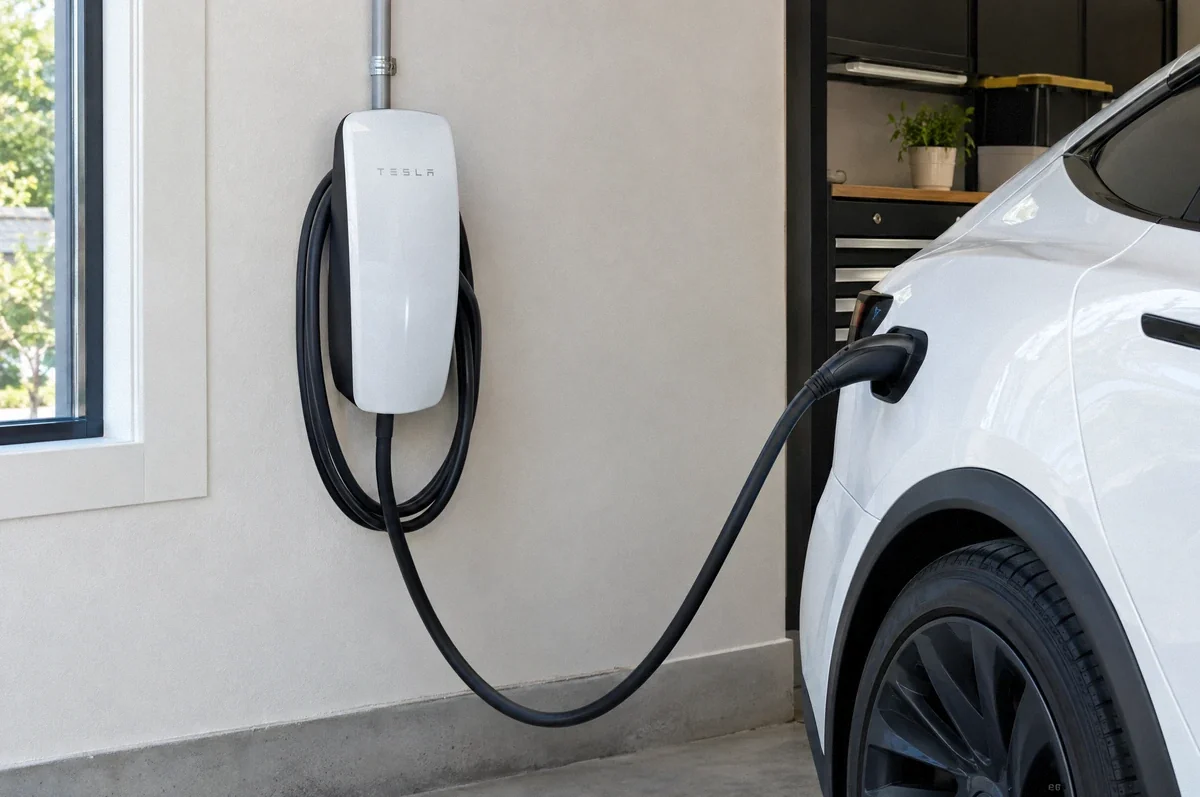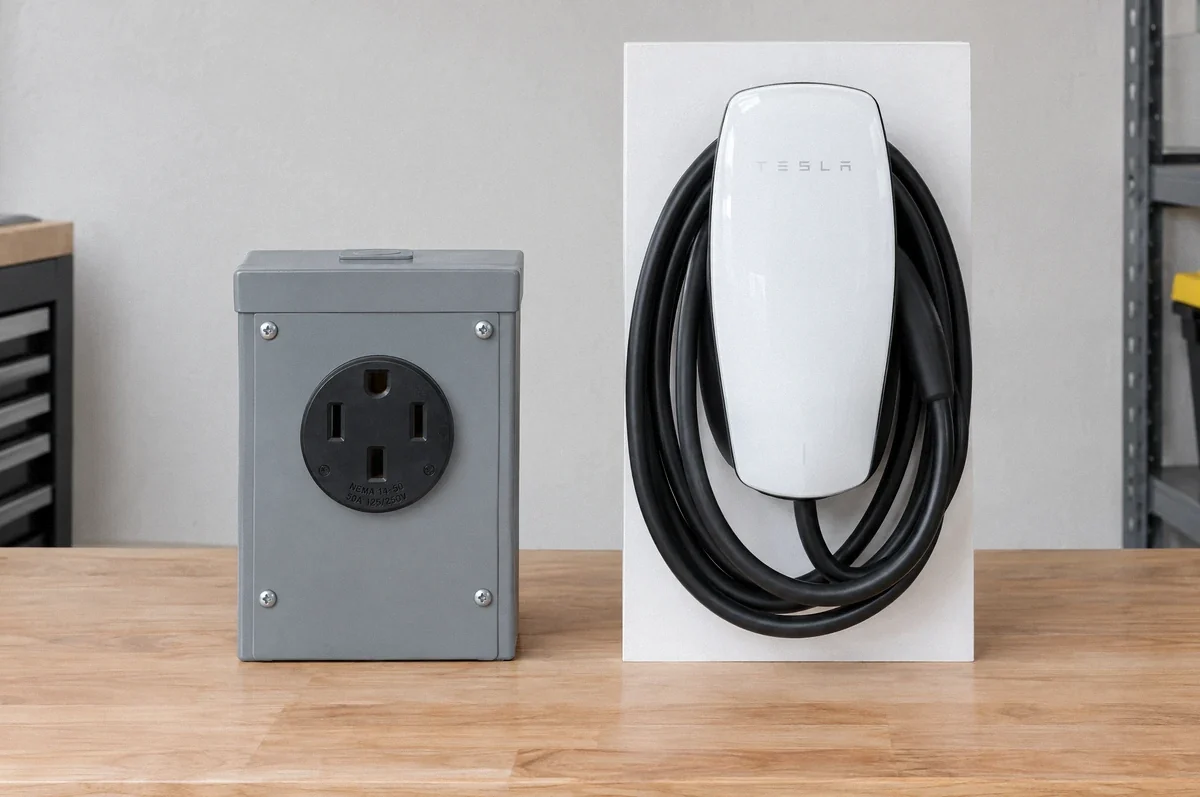
A Tesla Wall Connector is hardwired charging equipment. A NEMA 14-50 is a receptacle that needs compatible plug-in charging equipment. Compare those complete setups by the charging you need, their electrical requirements, and whether portability matters. An outlet is not automatically the cheaper installation, and hardwiring does not automatically make a vehicle charge faster.
The comparison is especially useful when you already own a Tesla Mobile Connector, have an existing 240-volt outlet, or are deciding what to install in a permanent parking space. It also applies to other brands, but their equipment limits and installation instructions can differ.
The main differences
| Question | Tesla Wall Connector | NEMA 14-50 with compatible plug-in EVSE |
|---|---|---|
| Connection to the house | Hardwired branch-circuit connection | Plug and receptacle |
| Tesla charging example | Up to 48 amps when the circuit and vehicle support it | Current Tesla Mobile Connector provides up to 32 amps with its 14-50 adapter |
| Lower configured output | Available within the product’s installation settings | Depends on the EVSE and approved adapter |
| Portability | Removal requires electrical work | Portable equipment can be disconnected and taken elsewhere |
| Protective equipment | Follows the hardwired product instructions and applicable code | Also requires receptacle protection appropriate to the installation |
| Multiple-car management | Supported arrangements depend on the exact Wall Connector model | Do not assume a portable unit offers equivalent features |
Tesla documents the Mobile Connector arrangement and the distinction between its home products in its home charging guidance. Its Wall Connector charging table lists circuit settings and output. Check the vehicle’s AC charging limit as well; product maximums are not guaranteed charging rates.
Why a 50-amp outlet does not mean 50-amp charging
EV charging is treated as a continuous electrical load. In a typical residential circuit design, a 50-amp circuit supports up to 40 amps of continuous charging, while 48-amp charging uses a 60-amp circuit. The conductors, breaker, connections, and equipment must all suit the design.
Those numbers are circuit limits, not promises about the device plugged into the outlet. A Tesla Mobile Connector limited to 32 amps stays limited to 32 amps on a correctly installed 50-amp circuit. Another listed EVSE might support 40 amps through an approved plug-in arrangement. The outlet configuration alone does not determine charging speed.
A hardwired unit can also be configured below its maximum. If both setups deliver the same current and the vehicle accepts it, their basic charging power is similar. The benefit of hardwiring is not an inherent speed increase at equal current; it is the connection method and the additional configurations available with appropriate equipment.
Estimate daily energy use and your parking window before paying for higher output. The home EV installation guide explains how to start with driving needs rather than an empty-to-full charging claim.
GFCI protection needs an equipment-specific answer
A ground-fault circuit interrupter, or GFCI, disconnects power when current escapes its intended path. New receptacle installations for EV charging generally require this protection under the applicable electrical rules. The EVSE’s internal charging protection does not automatically remove a requirement for the receptacle circuit.
Some equipment combinations can produce unwanted trips. ChargePoint’s Home Flex installation guidance recommends a hardwired arrangement when local code requires GFCI protection for the plug-in installation. This is a product-specific design option, not permission to omit required protection.
Hardwiring removes the receptacle from that design, but the installation must still follow its applicable protection requirements and the manufacturer’s instructions. A tripping breaker also must not be dismissed as harmless simply because nuisance tripping is possible. Equipment damage, moisture, a wiring fault, or other defects may require correction.
If protection trips repeatedly, stop the charging session and have the equipment and circuit evaluated. Do not replace a required GFCI breaker with an ordinary breaker, defeat grounding, or use an adapter to bypass the problem.
What an existing receptacle changes
A sound existing circuit can make plug-in charging practical. The electrician still needs to verify what that circuit actually is: its rating, grounding, conductor arrangement, protective devices, receptacle condition, and compatibility with the EVSE. A 14-50 faceplate is not evidence that the installation was sized or assembled correctly.
The receptacle must be suitable for the intended sustained use and installed to its instructions. Loose contacts, discoloration, heat damage, or a plug that no longer fits securely warrant evaluation. Repeated plugging and unplugging adds wear; portability does not require disconnecting the supply plug every morning.
Support the charging equipment as its manufacturer requires so its weight does not strain the receptacle. Keep connections protected from the actual environment and route the vehicle cable without a trip or vehicle-impact hazard. Household extension cords and unapproved adapters are not a solution to a badly located outlet.
An existing dryer circuit is a separate question. Voltage, circuit rating, grounding, permitted sharing equipment, and the charger’s configuration all need review. Do not assume that changing the receptacle or fitting an adapter converts the circuit into the charging setup you want.
Hardwiring, future moves, and a second car
Hardwiring suits a fixed parking location and removes one plug connection from the supply path. It does not permanently surrender ownership of the unit. An electrician can remove or replace it later and leave the circuit safely terminated; that work and any property agreement belong in the moving decision.
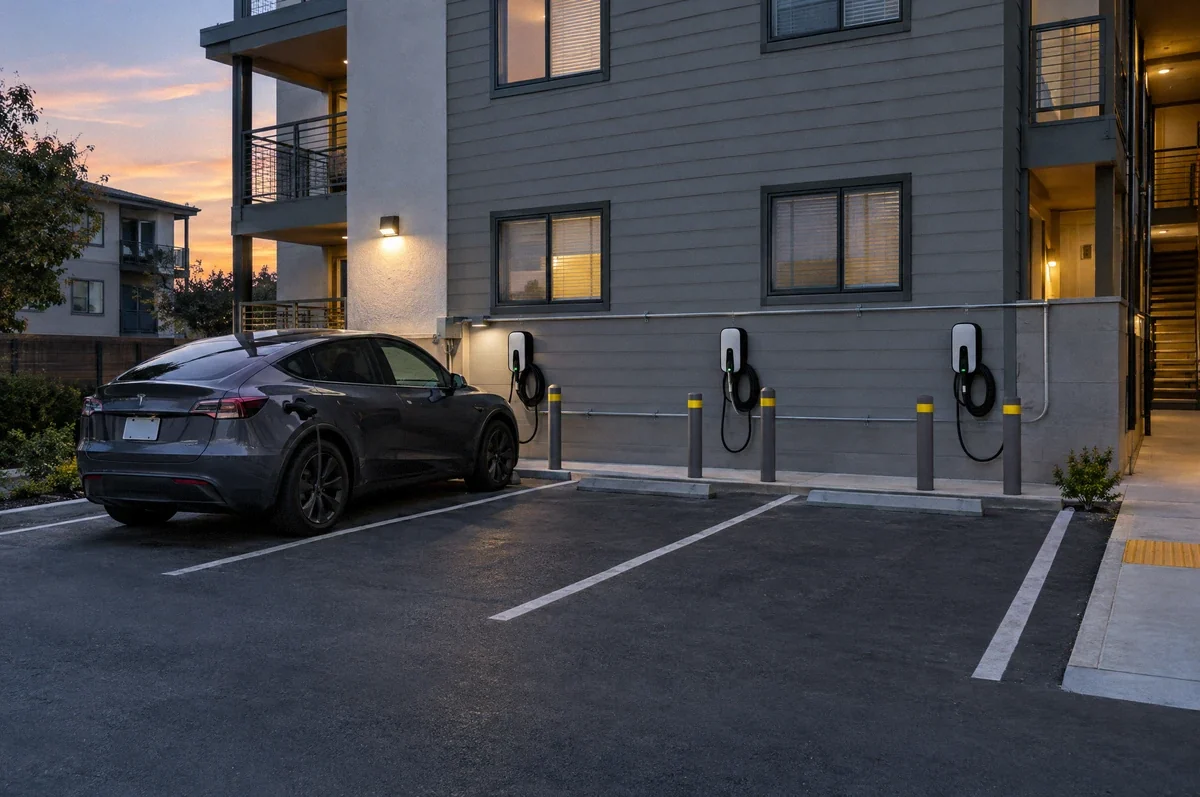
For two cars, compare a plan to share one charging cable with a plan for two charging ports. Two ports do not necessarily require twice the service capacity, but the chosen equipment and wiring arrangement must support managed charging.
Tesla’s Universal Wall Connector manual permits a specified daisy-chain arrangement on one branch circuit with a configured group limit. That allowance is for the Universal product and its documented arrangement. It does not justify connecting arbitrary chargers together or applying the same wiring scheme to every generation.
For the detailed product planning questions, read the Tesla Wall Connector installation guide.
Compare the complete installed scope
Ask for both options at the same parking location and useful charging output. Include the EVSE, receptacle if used, enclosure, breaker and protection, circuit route, mounting, permit, commissioning, and restoration. If one proposal includes a service upgrade and the other uses a lower charging rate, they are offering materially different projects.
Both options need a capacity assessment. A 200-amp panel does not guarantee spare capacity, and a 100-amp service does not automatically need replacement. Our EV panel-capacity guide separates equipment condition, circuit space, and actual demand.
For new circuit work, confirm the permit process with the city or county responsible for the address. Check landlord or association approval where relevant. Our rebates and permits guide covers application order and documentation without assuming a particular incentive applies.
Fox Electric can compare a plug-in installation with a hardwired home charging installation using your actual vehicle, circuit, and parking route. Request an assessment with the charger model and photos of the proposed location.