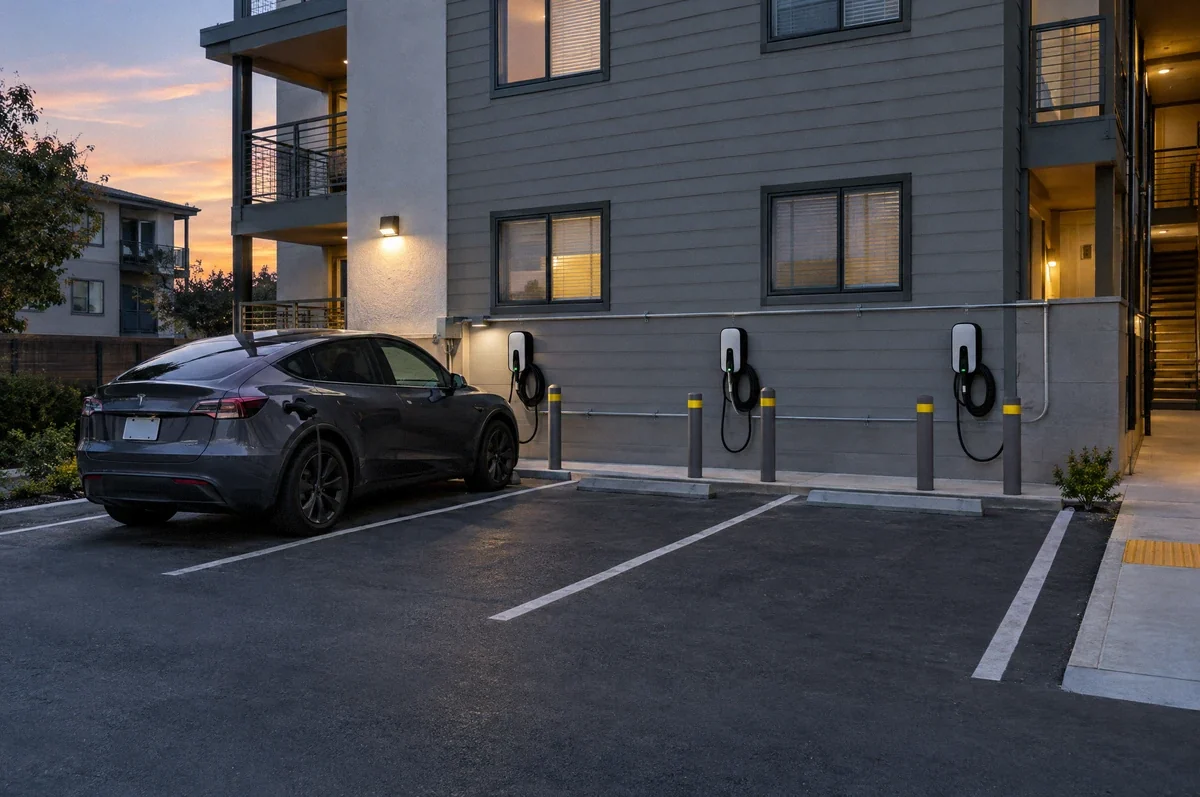
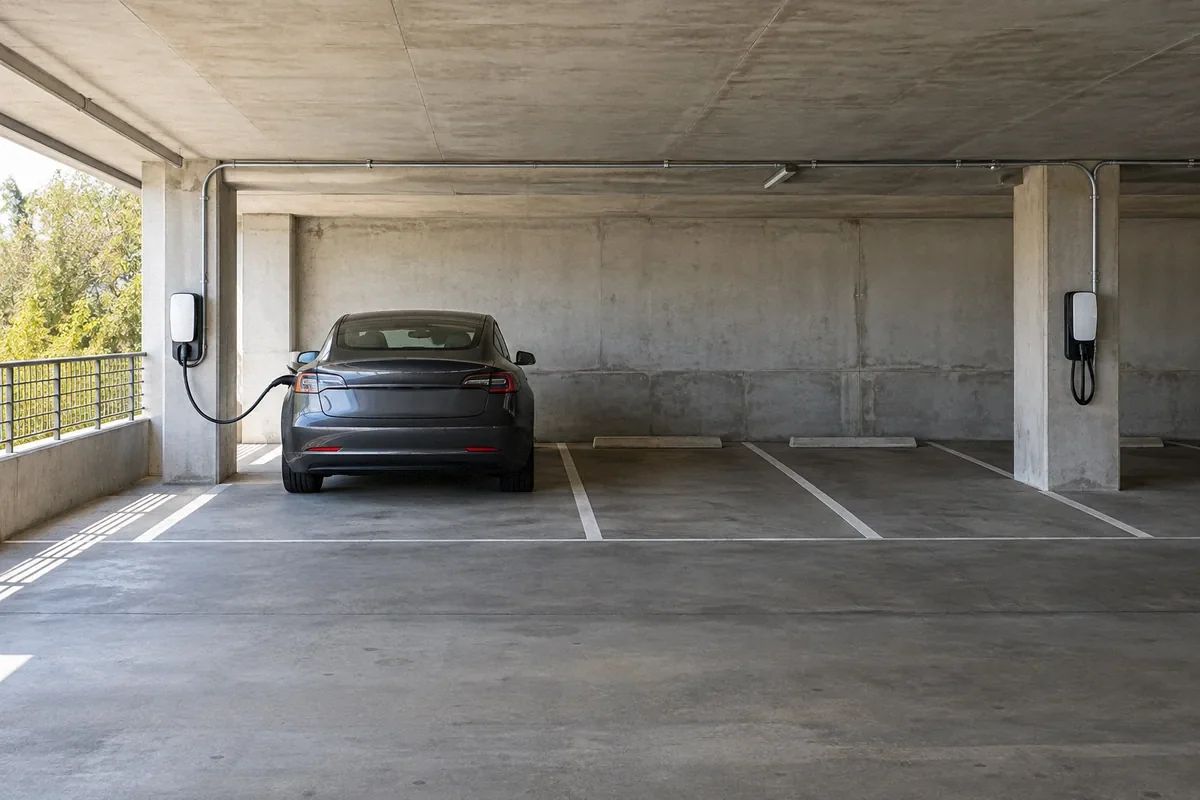
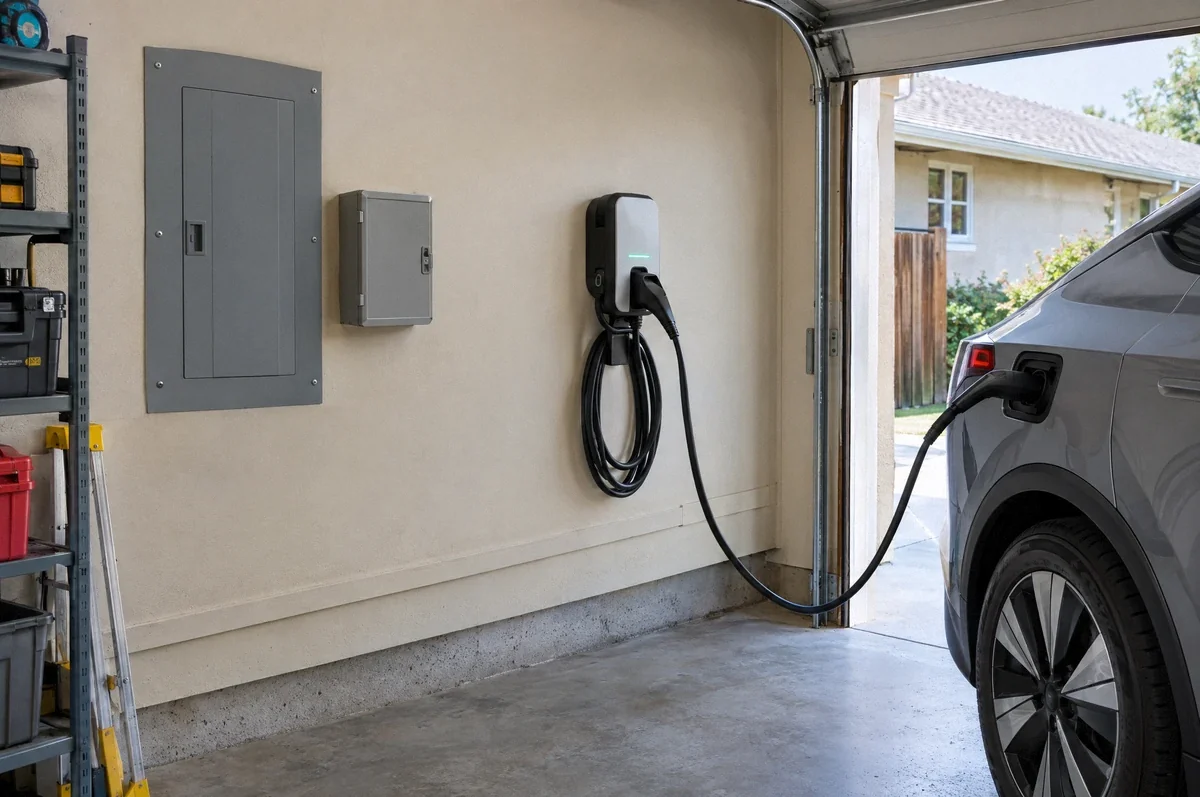
The cost of a home electric vehicle (EV) charger installation depends more on the electrical path than the charger brand. A short run from a modern panel can be straightforward. A detached garage, finished walls, limited service capacity, or a panel upgrade can change the project completely. Compare quotes by charging output, circuit route, panel work, permit responsibility, and restoration.
First decide how much charging you need
Level 2 charging uses a 208- or 240-volt supply, with 240 volts common in single-family homes. Its output can vary widely. Start with your typical daily driving, how long the vehicle remains parked, the vehicle's onboard charging limit, and the charging equipment instructions. Paying for the highest possible output may add panel work without improving your routine.
Tesla's current Wall Connector table shows output settings from 12 to 48 amps and explains that charging speed also depends on the vehicle. Other manufacturers publish their own requirements. The circuit, breaker, conductors, and configured output must work as one approved system.
The main cost components
- Site assessment and design: panel identification, available capacity, route, mounting location, and equipment specifications.
- Charging equipment: a hardwired charger or a compatible portable charger and outlet arrangement.
- Branch circuit: the breaker, conductors, conduit or cable, fittings, supports, and connections from the panel to the charger.
- Routing: attic, crawlspace, finished walls, exterior conduit, trenching, fire-rated construction, or a detached structure each affects labor and restoration.
- Capacity work: a load calculation, load management, panel work, or a service upgrade when required.
- Permit and inspection: the authority and fee depend on the property address.
Hardwired charger or NEMA 14-50 outlet
A hardwired charger connects directly to the circuit. A NEMA 14-50 is a specific 240-volt receptacle configuration used with compatible plug-in equipment. The outlet is not the charger. A quote for an outlet must account for the receptacle, enclosure, conductors, required protection, and the portable charging equipment you intend to use.
Hardwiring can reduce the number of plug-and-receptacle connections and may support features such as networked controls or higher configured output, depending on the product. A plug-in setup offers portability. Neither choice is universally cheaper because the route and capacity work often dominate the project. See our detailed comparison.
When panel work enters the quote
An open breaker space does not prove that the service has capacity. The electrician should run a load calculation, a code-based worksheet that estimates household demand. If capacity is limited, options may include reducing charging output, using listed load management, selecting different equipment, or upgrading the service.
Contact the serving electric utility when the service changes or the added load requires review. Where PG&E serves the address, it includes EV charging among added-load projects in its Building and Renovation guidance. Palo Alto and Santa Clara operate municipal electric utilities with separate processes. The utility scope should be separated from assumptions in the contractor's proposal.
Permits are local
The California Energy Commission advises homeowners to have panel capacity checked and use appropriate permitting for new charger circuits. San Mateo County lists residential EV charger applications in its online permit system for unincorporated properties. Santa Clara County has a separate permit portal. Fremont uses its own Building and Safety process. Properties inside other cities use the corresponding city department.
How to compare estimates
- Use the same charger model, output, and mounting location for every quote.
- Ask for the assumed route and approximate circuit length.
- Confirm whether wall repair, trenching, paint, or concrete work is included.
- Ask what supports any panel upgrade recommendation.
- Confirm who obtains the permit and schedules inspection.
- Separate charger hardware, electrical installation, capacity work, and uncertain utility work.
Rebates and tax incentives
Programs change, close, and apply eligibility rules. Check the current program page before treating an incentive as part of the budget. PG&E maintains EV resources, and the federal Alternative Fuels Data Center tracks laws and incentives. Confirm location, income, equipment, labor, and filing requirements with the program administrator or tax professional.
Request a site-specific quote
Fox Electric installs permitted home charging circuits in the San Francisco Bay Area. Visit our EV charger installation service or call (650) 550-0719. We can compare charging outputs and routes, check panel capacity, and identify which parts of the quote are confirmed.