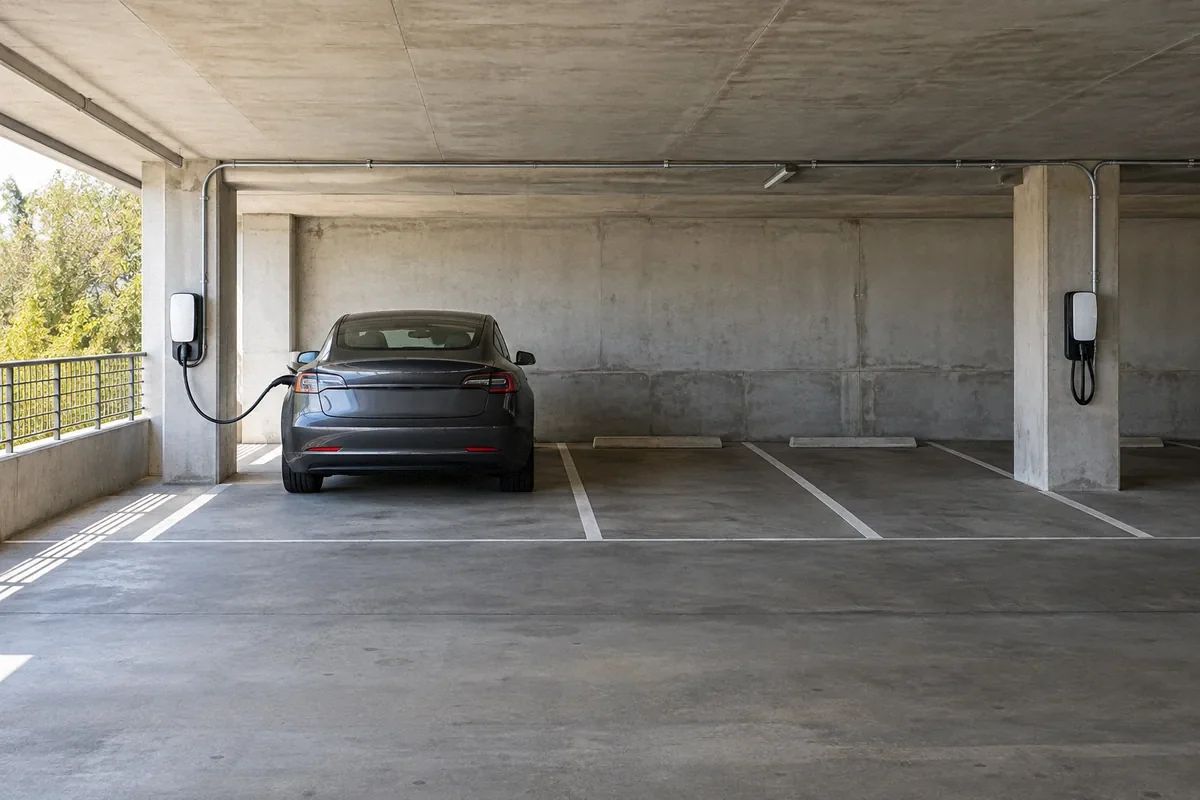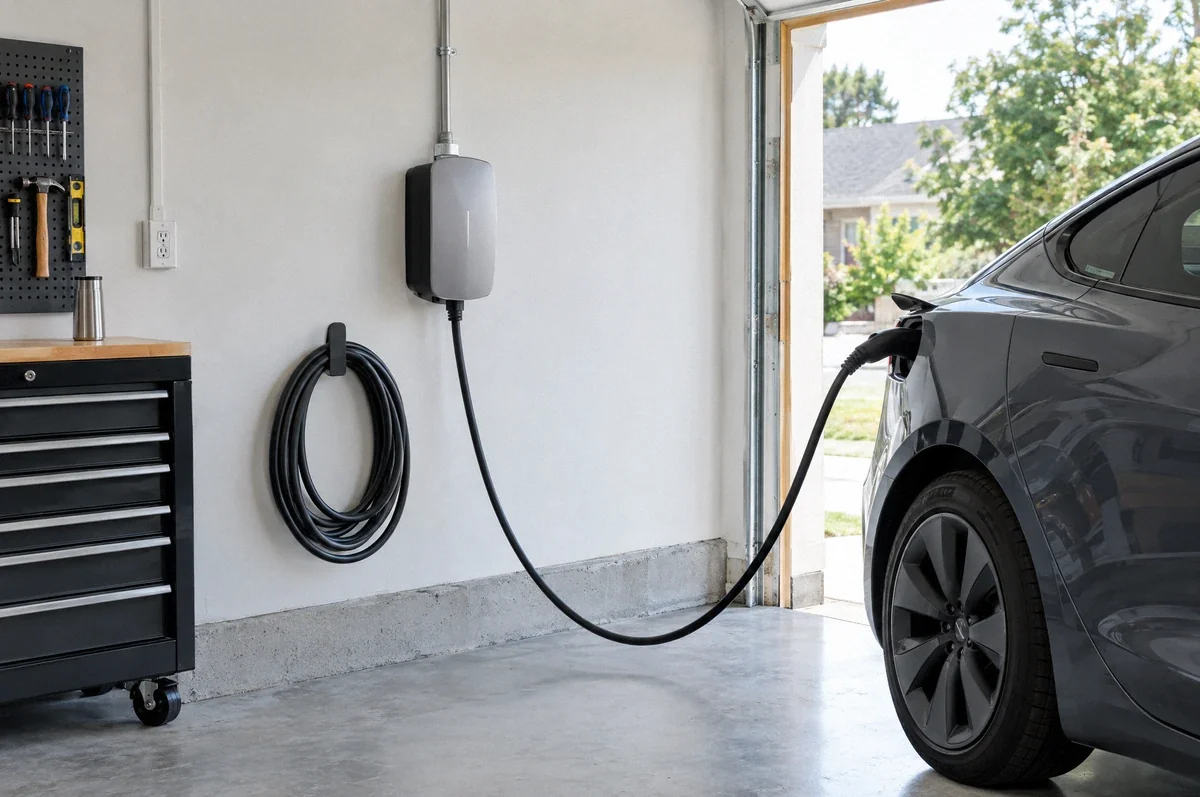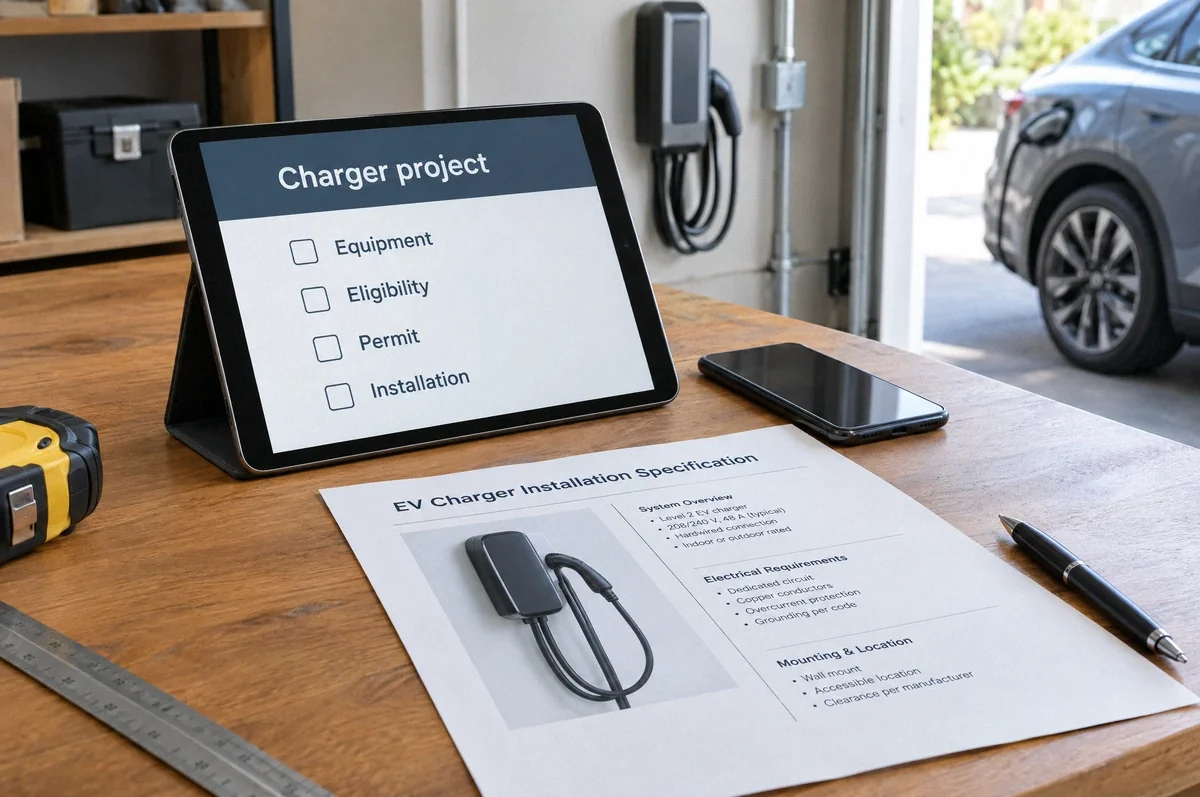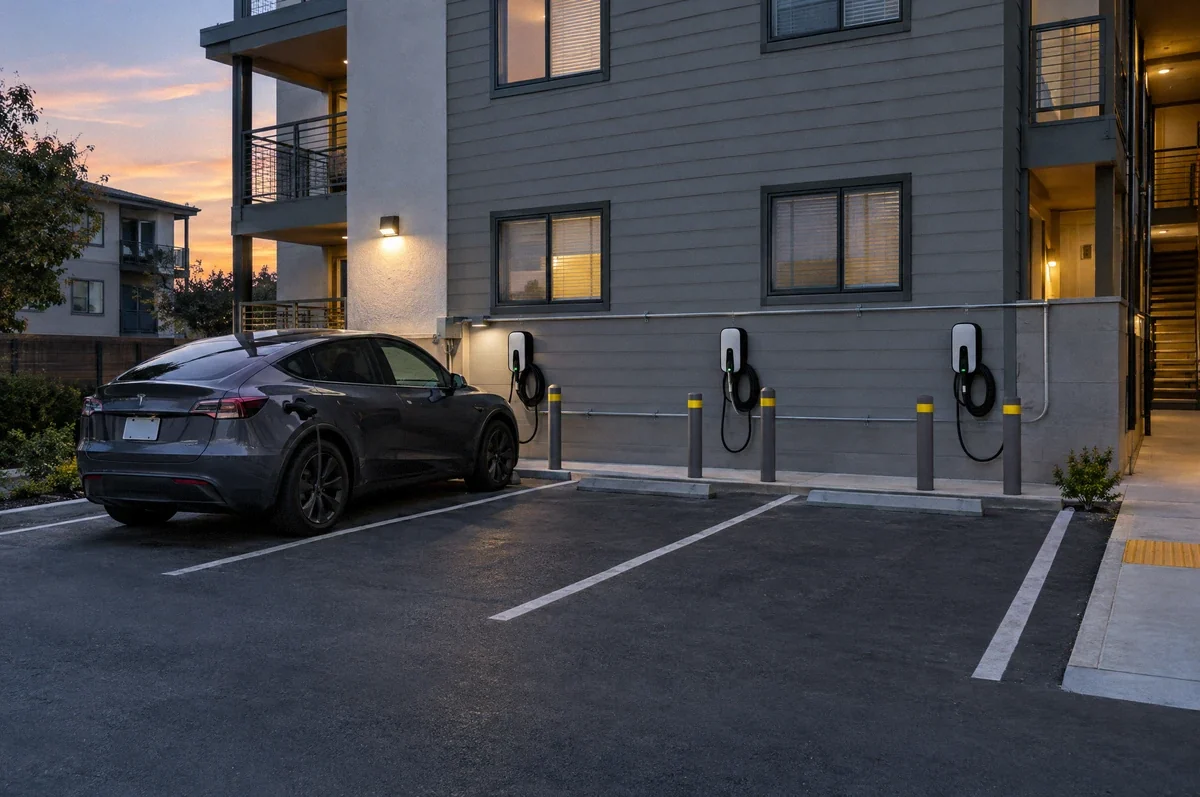
A shared EV charging project should begin with an operating plan: who will charge, how long vehicles will park, how much energy they need, and who will pay. Those decisions determine the number of ports, useful charging power, billing system, and electrical infrastructure. Buying several chargers first leaves the most consequential decisions unresolved.
This guide is for boards, property managers, business owners, and fleet operators planning a property-wide system. A resident seeking one charger at an assigned space has a different starting point; see our individual condo charging guide.
Define the users and their departure needs
An apartment resident may leave a vehicle parked overnight. An employee might have a full workday. A service van may return late and need to depart early, while a retail customer may stay less than an hour. The same charger output produces very different value in those settings.
Collect likely daily energy demand, arrival and departure times, vehicle types, and the number of simultaneous users. For a fleet, use route and vehicle records rather than employee-commute assumptions. Seasonal routes, payload, auxiliary equipment, and reserve requirements can alter the charging plan.
Separate the number of parking spaces from the number of ports that can charge vehicles simultaneously. A pedestal may have more than one connector without providing full independent output to each vehicle. Specify simultaneous service explicitly in equipment comparisons.
Set a measurable first-stage objective, such as supplying a defined group of resident vehicles during their overnight parking window. Then identify the later-stage demand the infrastructure should accommodate. This makes the proposed expansion more concrete than a promise that the project is future-proof.
Select charging power by the parking window
Level 1 charging uses 120-volt power. Level 2 commonly uses 208- or 240-volt power. DC fast charging supplies direct current to the vehicle and generally creates a larger utility and equipment project. These are charging categories, not interchangeable labels for speed.
The Department of Energy’s infrastructure planning guidance recommends considering Level 1 and Level 2 for workplaces and multifamily housing, and Level 2 or DC fast charging for public sites. Use that as a starting point, then test it against the property’s actual energy and departure needs.
Long parking periods can make multiple lower-power ports more useful than a few high-power ports. A fleet with short turnaround times may need higher output or a mix of charging types. Conversely, the word “fleet” does not by itself establish a need for DC fast charging.
Document connector compatibility for the vehicles expected at the site. Include adapters only where the equipment and vehicle manufacturers support them. Keep chargers and cables positioned for the actual variety of vehicle inlet locations.
Establish an electrical allocation for charging
The electrical review should identify the service, distribution equipment, candidate meters, feeders, available breaker positions, equipment condition, and the demand method accepted for the project. In a shared property, the nearest panel may belong to a different account or have limited usable capacity.
Managed charging can distribute a defined power allocation among ports. A system that also responds to building demand needs the appropriate metering, control, and approved design. Neither function automatically removes the need for correctly sized conductors, overcurrent protection, or a compatible circuit arrangement.
For illustration, ten vehicles each needing 12 kilowatt-hours require 120 kilowatt-hours before charging losses. A total 20-kilowatt allocation operating for eight hours has a theoretical 160-kilowatt-hour energy budget. That arithmetic does not prove the design works: arrivals, departures, vehicle limits, losses, minimum operating rates, and control behavior affect delivery. It does show why port count and peak power should be evaluated separately.
Ask the designer to describe the busiest credible charging period, the minimum expected service per vehicle, and how priorities are assigned. A group of chargers that divides power equally may not suit vehicles with different departure deadlines.
Our electrical capacity guide explains basic distinctions between circuit space and available power. A commercial project needs that analysis at the appropriate building and distribution scale.
Decide how drivers pay and who owns the system
Identify the owner of the electrical infrastructure, charging equipment, software account, and usage records. Those can be different parties. Also identify who receives the utility bill and who handles resident or employee support.
Possible operating models include employer-funded charging, assigned equipment on an individual account, common-power charging with usage allocation, and payment through a charging network. A new utility meter may simplify accounting but can add construction, account charges, and utility review. A network can record driver sessions without automatically being a utility-approved billing meter for every use.
Before selecting the billing method, review applicable tariff and transaction requirements with the utility, network provider, and relevant advisers. The Department of Energy’s multifamily guidance identifies parking access, electrical service, and billing as distinct property-planning issues.
Create a written policy for authorized users, idle vehicles, guests, pricing changes, reimbursements, damaged cables, and unavailable equipment. A board should know the recurring network, transaction, communications, and maintenance costs before approving the equipment purchase.
Put accessibility and construction on the first drawing
Charger placement affects access aisles, accessible routes, reach to controls, cable handling, vehicle maneuvering, and existing parking. A charger near the electrical room may still be in a poor location for a driver who needs clear space beside the vehicle.
The U.S. Access Board’s EV charging design recommendations distinguish technical assistance from legally binding standards. California requirements, applicable federal obligations, and project-specific scoping need review by the appropriate design professionals and permit authority. Do not treat an accessible parking stall with a charger added as proof that the charging installation is accessible.
California’s 2025 CALGreen residential measures, effective January 1, 2026, include EV infrastructure provisions for covered residential construction. Project type, parking work, exceptions, and local requirements affect the applicable scope. EV-capable infrastructure, EV-ready spaces, and installed charging equipment are different deliverables; define each in the plans.
Survey underground routes, pavement restoration, drainage, protective barriers, fire-rated penetrations, and communications coverage. Where future expansion is realistic, evaluate spare conduit and distribution capacity while excavation is already planned.
Coordinate the utility, permit, and procurement schedule
Confirm the electric provider for the address. Some Bay Area properties use PG&E; others use municipal utilities. A new charging meter, larger service, or transformer work follows the provider’s own assessment and schedule, separate from the building permit.
The first project budget should separate customer-side electrical work, utility work, civil construction, equipment, software, and ongoing operation. Incentives should remain conditional until their administrator confirms eligibility, application order, funding, and equipment requirements. Our EV permits and incentives guide also explains why old federal-credit assumptions can be wrong for a new project.
Before selecting a network, request its documented behavior when internet access is lost, its data-export options, and the conditions for changing providers. Ask which functions require subscriptions and which party owns the administrator account. A claim of open compatibility should be verified for the exact hardware, firmware, and intended replacement network.
Commission the system as an operating service
Acceptance should demonstrate charging at multiple ports, configured group limits, user access, billing records, and response to expected faults or communication loss. Retain drawings, equipment records, account access, permit closeout, and a maintenance contact. Assign a person to monitor failed sessions and damaged equipment after installation.
Fox Electric can scope the building-side work for commercial EV charging and coordinate related commercial electrical work. Send the site plan, planned users, parking counts, and available electrical records to begin a property-level assessment.