A home EV charger should replace the energy you use between parking and your next departure. Start with that requirement, then check the electrical supply and the route to the car. The highest charging rate on a product page is not automatically the best installation for your house.
For Bay Area homeowners, the main decisions are charging speed, equipment compatibility, available capacity, and placement. Permits, property approvals, and utility requirements follow the actual address and work involved. Planning these together helps avoid buying a charger that requires electrical work you did not expect.
Start with daily driving and available charging hours
Level 1 charging uses a suitable 120-volt circuit. Level 2 uses a higher-voltage supply, commonly 240 volts in a house and sometimes 208 volts in shared or commercial buildings. The equipment on the wall is electric vehicle supply equipment, or EVSE: it controls the delivery of electricity to the vehicle. In normal AC home charging, the vehicle’s onboard charger converts that electricity for the battery.
Level 1 can be enough for light daily driving with a long parking window. It should not be dismissed simply because the vehicle has a large battery. Conversely, a short overnight window or substantial daily driving can make Level 2 useful. The U.S. Department of Energy explains these charging categories in its charging equipment guide.
Estimate how much energy your driving uses rather than assuming the battery starts empty every evening. As an illustrative calculation, 36 miles of driving at 3 miles per kilowatt-hour uses about 12 kilowatt-hours. Charging losses and cabin or battery conditioning add to the electricity drawn from the house. Your car’s own consumption history is a better input than that example.
A 240-volt supply at 16 amps provides approximately 3.8 kilowatts before losses. At 32 amps it provides about 7.7 kilowatts. Both can replace useful amounts of energy during a long parking window. Whether either meets your needs depends on your vehicle, driving, and charging hours. A larger circuit cannot overcome the vehicle’s own AC charging limit.
Choose equipment that fits the car and the installation
Check the exact charging inlet on the vehicle, the connector supplied with the EVSE, and any adapter approved for that combination. A shared brand name or a familiar plug shape does not establish compatibility. Also consider a second vehicle you realistically expect to own, rather than an unspecified future fleet.
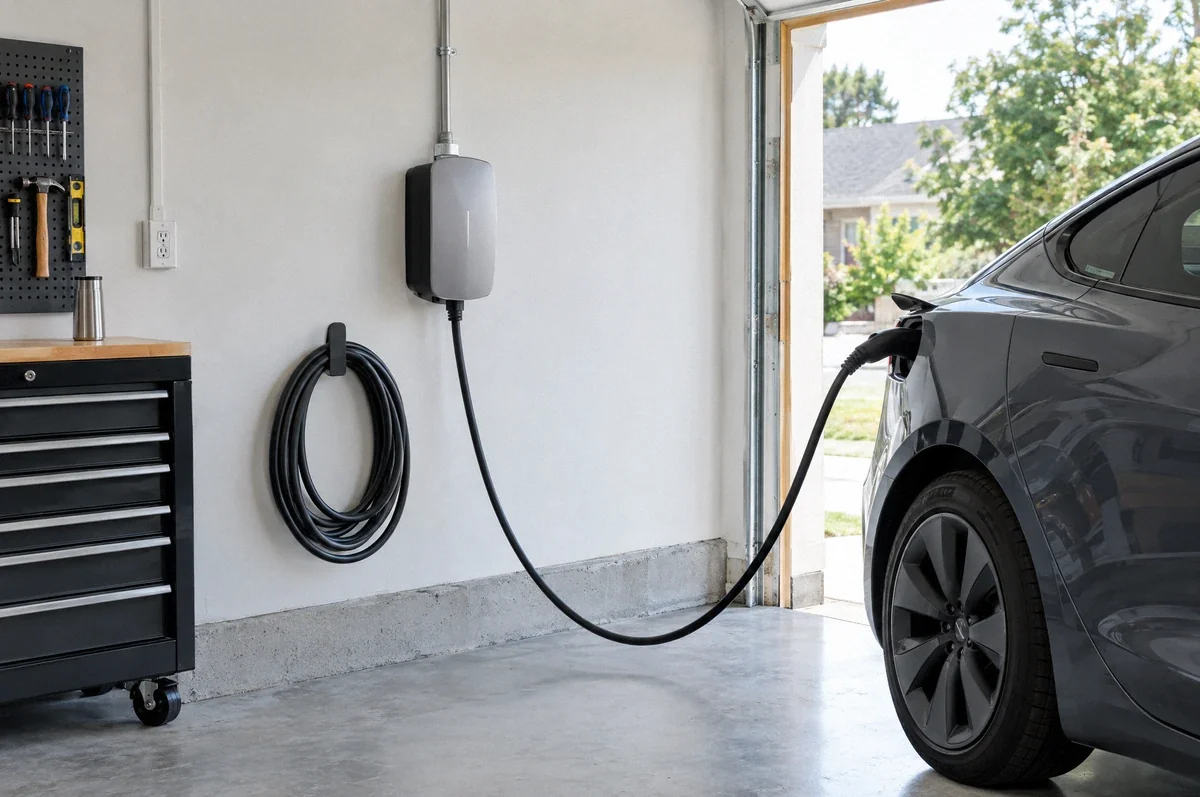
Home installations commonly use either a compatible plug-in EVSE or a hardwired unit. A NEMA 14-50 receptacle is a particular outlet configuration; it is not charging equipment by itself. Hardwiring connects compatible EVSE directly to the branch circuit and removes the plug and receptacle connection.
Some equipment is sold for both connection methods, while other models are hardwired only. Tesla’s Wall Connector and Mobile Connector are different products, for example. Our hardwired versus NEMA 14-50 comparison explains their practical differences, including why a 50-amp outlet does not necessarily deliver 40 amps to the vehicle.
For plug-in charging, the electrician must evaluate the receptacle, circuit, enclosure, required ground-fault protection, and equipment instructions. A ground-fault circuit interrupter, or GFCI, disconnects power when it detects current taking an unintended path. An old range or dryer outlet should not be accepted for charging based on appearance alone.
Separate panel condition, breaker space, and capacity
An electrical assessment answers three different questions. Is the equipment in suitable condition? Can it accept the correct breaker? Can the service and any feeder supply the proposed load? A feeder is the wiring that supplies a secondary panel or other distribution equipment.
A panel with empty breaker positions may have little available electrical capacity. A panel with no free positions may still have capacity but require a different distribution arrangement. A subpanel adds places for circuits and can simplify a route; it does not increase the amount of power delivered by the utility.
A load calculation is a code-based assessment of electrical demand using the home’s actual loads. It is different from adding every breaker handle number, and different from reading one month’s electricity bill. An approved method using measured demand may also be available in an appropriate project. The electrician and permit authority must establish the method that applies.
PG&E’s home EV planning guidance recognizes that 100-amp homes may support charging, with evaluation or upgrades depending on conditions. Our 100-amp service guide covers lower configured output, suitable load management, and circumstances that justify a service upgrade.
Scheduling a charger overnight can help with rates and convenience. A schedule alone does not establish electrical capacity or replace a protective load-management system.
Walk the route before selecting the mounting location
Park the car where it normally sits and identify its charging port. Check that the charging cable can reach without crossing a walking route, being pinched by a garage door, or lying where tires regularly pass over it. Consider both vehicles if they will share the location.
Then review possible routes from the electrical supply. A short surface route through an accessible garage differs substantially from a route through finished rooms or an underground run to detached parking. The estimate should describe wall penetrations, exterior exposure, trenching, restoration, and any fire-rated construction affected.
Longer runs increase material and labor and may require larger conductors after voltage-drop and installation conditions are evaluated. Wire size is not chosen by distance alone. Wiring method, temperature ratings, grouping, equipment terminals, and circuit design all matter.
Outdoor equipment and connections need ratings appropriate to their exposure. Keep service access and electrical working space clear. A neat location that blocks the panel or requires stretching a charging cable is not a workable location.
Plan the permit and identify the actual utility
Installing a new charging circuit or permanently connected EVSE generally requires an electrical permit and inspection. Using compatible portable equipment on an existing suitable circuit is a different scope; confirm any permit question with the jurisdiction. The San Mateo County permit page is one starting point for unincorporated properties, while incorporated cities handle their own permits.
The electric utility is not always PG&E. Palo Alto, Santa Clara, and Alameda have municipal electric utilities, among others in the region. Confirm the provider from the service address and bill. A charging circuit inside an existing adequate service can be a different utility project from increasing service capacity or changing metering.
Check incentives before purchasing equipment or starting work because application order and approved products can matter. Our rebates and permits guide explains the current checks. Compare electricity plans using the whole household bill, charging hours, and actual tariff rather than assuming an EV rate must save money.
What the proposal and handover should include
A useful proposal identifies the EVSE model, configured output, circuit and route, capacity findings, permit work, restoration, and any utility scope. It should distinguish confirmed work from conditions that still need inspection. For cost comparisons, see the EV charger installation cost guide.
At completion, retain the permit record, final inspection result, equipment information, and configured charging limit. Ask for a demonstration with your vehicle and an explanation of normal indicators, scheduling, and any load-management behavior. Do not increase the commissioning limit later simply because an app offers a higher setting.
Fox Electric can assess the electrical supply, parking location, and proposed equipment for home EV charger installation. Send your vehicle model, parking photos, and accessible closed-panel information to start a scope review.