A ceiling fan and a bathroom exhaust fan can look like similar electrical replacement jobs, but they serve different purposes. A ceiling fan circulates room air. A bathroom exhaust fan moves air out through a duct or another approved exterior discharge arrangement. Their support, wiring, controls, and performance need different checks.
Before buying either product, identify the existing installation and the problem you want to solve. A larger fan or a quieter motor will not correct every support, duct, or control issue. The useful assessment considers the complete installation, including what is hidden above the ceiling.
A light-fixture box is not automatically a fan support
A ceiling fan needs a support arrangement approved for the selected fan and installation. Its rotating assembly creates requirements different from those of a stationary light fixture. The electrical box, brace or structural support, bracket, and fasteners must work together.
Hunter’s installation guidance calls for verification of an appropriate fan-rated box or a supported structural mounting method. The existing light staying in place is not proof that its support can be reused for a fan.
The installer should verify the rating and attachment, not assume that every old box needs replacement or that every round box is fan-rated. If support work is necessary, the access method should be included in the estimate. An accessible attic and a finished room above the fan can lead to different scopes.
For a heavy stationary fixture instead of a fan, see chandelier installation planning. The relevant support rating still depends on the actual product and assembly.
Check blade clearances and the mounting system
Measure ceiling height, slope, room dimensions, and nearby obstructions before selecting the fan. The installed blade height matters, not simply the ceiling height. A long downrod or a deep motor housing changes the result.
Follow the exact manufacturer’s minimum clearances and mounting instructions. A low-profile model may suit some lower ceilings, while a sloped ceiling may require a compatible adapter or downrod. Do not assume any fan can be made to fit by shortening parts or changing the bracket.
Consider access for cleaning and service. A fan over a stair or a high vaulted room can require special access equipment. Its light kit and remote receiver may also have future maintenance needs.
The intended airflow should suit the room and use. A fan can improve perceived comfort where people are present, but choosing an oversized or excessively fast unit can create an uncomfortable draft or noise.
Match fan and light controls separately
A ceiling fan may combine a motor, light, remote receiver, and wall controls. Those parts must be compatible. An ordinary lighting dimmer should not be assumed suitable for controlling fan speed.
Decide whether the fan and light should operate separately and from which locations. Existing wiring may support some arrangements but not others. A supported remote can change the control options, though it still needs a defined pairing and maintenance plan.
If several wall locations control the existing light, review the multi-location switching arrangement before replacing the fixture. For connected functions, identify exactly what is included in the smart-home setup and what remains with the equipment provider.
A bathroom fan needs an effective air path
For an exhaust fan, the motor is only part of the system. The duct’s size, length, bends, condition, and exterior termination affect the air it can move. A higher-rated replacement may not deliver its expected performance through a restricted or unsuitable existing route.
Airflow is commonly expressed in cubic feet per minute, or CFM. Noise is often expressed in sones. Compare these ratings alongside the product’s installation requirements, rather than choosing only by the largest airflow number or lowest advertised sound level.
Broan-NuTone’s exhaust-fan buying guide emphasizes matching the fan to the bathroom and checking duct compatibility for a replacement. The installer also needs to determine whether the existing system actually exhausts outdoors by an approved route.
A duct ending in an attic does not provide the intended exterior exhaust. If a new roof or wall termination is needed, identify who performs that work and restores the building envelope. Electrical installation, duct work, and roofing may involve different responsibilities.
Evaluate the existing problem before replacing equipment
Describe whether the bathroom stays damp, the fan has become noisy, air seems weak, or the control no longer works. These observations help distinguish a motor problem from a duct restriction, failed damper, unsuitable control, or another condition.
A humidity-sensing control or timer can help a fan operate for the intended period, but it does not fix an inadequate duct. Where applicable CALGreen provisions require humidity control, a timer alone is not a substitute. The code includes an exception for fans serving as part of whole-house ventilation. See the 2025 CALGreen residential mandatory measures, section 4.506.1. A new grille may change appearance without changing ventilation performance. A fan with a heater adds electrical demand that must be assessed separately from a basic exhaust fan.
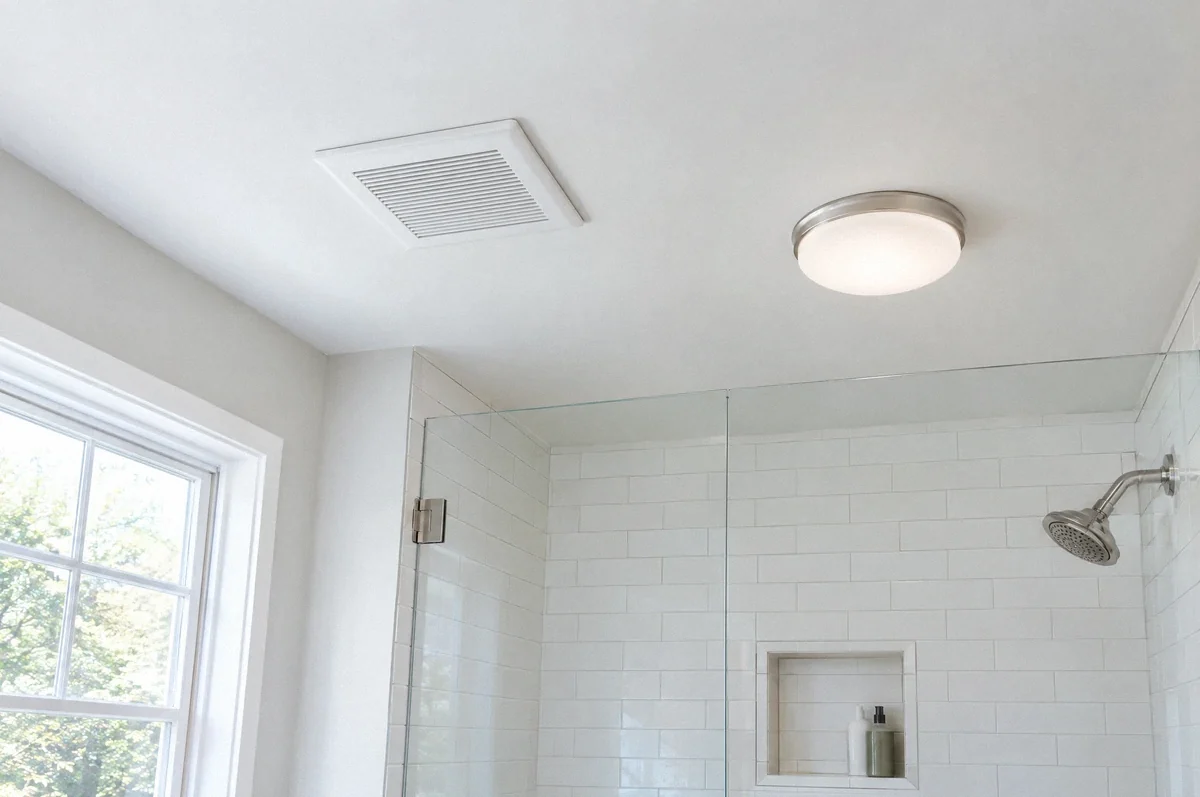
If the device is in or near a shower or tub area, the selected model and installation must be suitable for that location and its required protection. Do not infer suitability from the appearance of a white ceiling grille.
For a larger bathroom or home wiring project, coordinate the exhaust arrangement with the remodel plans before finishes close.
Permits, electrical supply, and the written scope
Requirements depend on the actual work. A compatible replacement, a new circuit, a relocated fan, and a new exterior duct are different scopes. San José’s mechanical-project guidance identifies a mechanical permit for exhaust-fan installations and replacements. Confirm any electrical work and duct changes with the property’s permitting authority as part of the complete scope.
Ask the estimate to state the fan model or allowance, support or housing changes, electrical supply, controls, access method, and expected finish repairs. For a bathroom fan, include the duct and exterior termination assessment. For a ceiling fan, include any special access equipment and the approved mounting arrangement.
Do not assume patching, painting, roof work, or a new dedicated circuit are included in a basic installation price. The selected equipment instructions and site assessment determine which of those items are necessary.
Check the result at handoff
Review ceiling-fan operation through the supported speeds and light settings. Unusual wobble, rubbing, or other unexpected behavior should be addressed, not accepted as normal merely because the fan turns.
For a bathroom fan, review its controls, intended operating period, and the ventilation checks included in the scope. Keep the product information and maintenance instructions. Record who handles any equipment warranty claim and who maintains the duct or exterior termination.
Fox Electric’s ceiling-fan installation service can assess the electrical and support work. Send the fan model, room photographs, and your main concern so the visit can establish the appropriate installation scope.