
If your electric vehicle (EV) charger repeatedly trips its breaker, stop charging on that circuit and arrange diagnosis. Possible causes include excessive configured current, a circuit fault, a damaged connection, equipment trouble, or a protection compatibility issue. The timing is useful evidence, but it does not identify which part needs replacement.
Do not install a larger breaker, bypass protection, use an improvised adapter, or repeatedly reset the circuit. If you notice smoke, active arcing, fire, or signs of a developing fire, leave the area and call 911.
Did the breaker trip, or did charging stop?
A stopped charging session is not always a tripped breaker. Vehicle scheduling, an equipment fault, access settings, or load management can pause charging. Load management is a control system that limits charging to stay within the available electrical capacity.
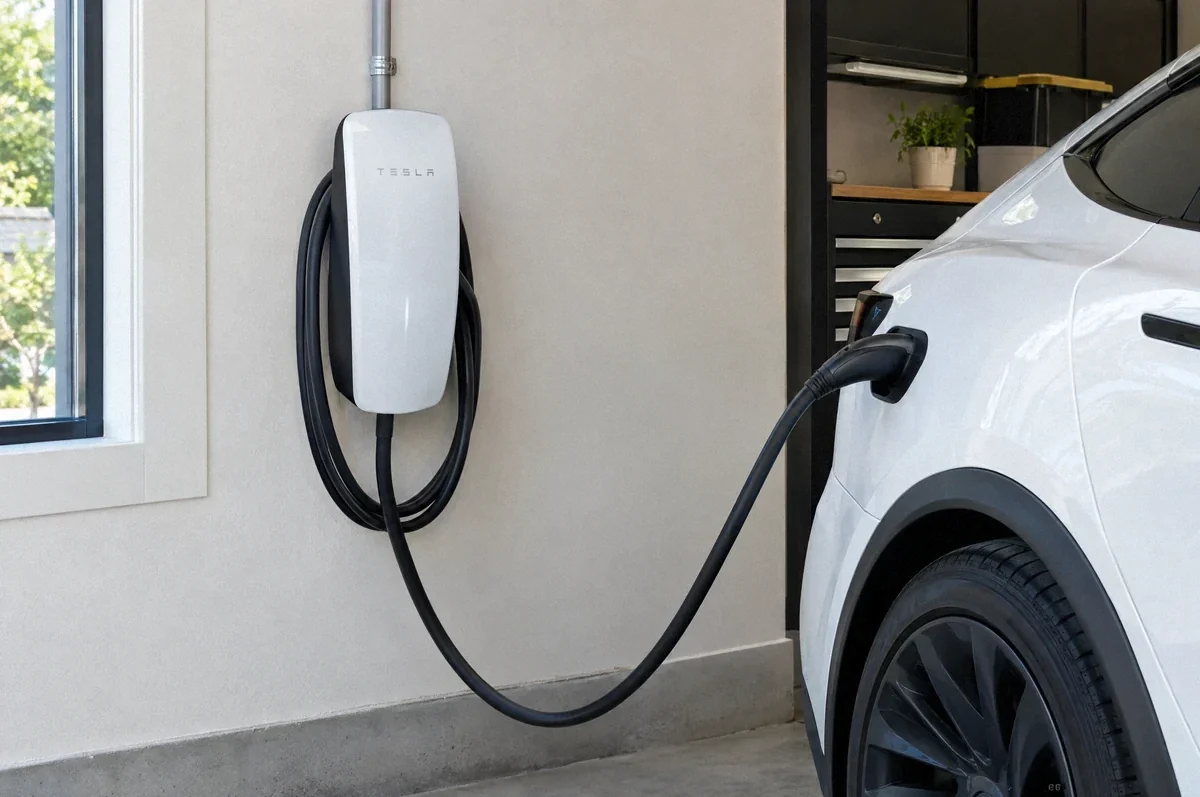
Record what the vehicle and charger display. Note the breaker’s visible position only if the panel is safely accessible and intact. Do not remove covers or touch suspect equipment. Tesla’s Wall Connector support page distinguishes status lights and provides a model-identification and diagnostic process. Use the instructions for your charger and generation, not a code chart for another product.
What the timing can tell the electrician
| Pattern | Questions for the investigation |
|---|---|
| The breaker opens as charging starts | Is there a circuit or equipment fault? What type of protective device operated? |
| Charging runs for a while before the trip | Do configured output, sustained load, connections, and equipment conditions match the installation design? |
| It happens after rain or moisture exposure | Is water entering equipment, a connection, or the charging handle? |
| It started after charger, breaker, or panel work | Were the equipment, connections, protection, and commissioning checked together? |
| Charging stops while the breaker stays on | Does a vehicle setting, charger fault, or load-management event explain the interruption? |
These are diagnostic questions, not permission to continue testing a recurring fault. Tell the electrician how long charging had been underway and whether the event occurs consistently.
Check the configured current against the circuit design
The charger setting, breaker, conductors, terminals, and equipment instructions must agree. A charger capable of a particular output does not make every existing circuit suitable for that output. The number on a breaker is not a universal charging-current setting.
Tesla publishes charging output and circuit requirements for its equipment. The installer must apply the relevant instructions and local requirements to the actual installation. Do not enter installer settings or change the breaker’s rating based on a generic online table.
Reducing vehicle charging current can change the symptom. It does not prove that a loose or damaged connection is safe. Report any previous setting change as part of the history instead of treating it as a completed repair.
Plug-in and hardwired installations have different connections
A plug-in charger adds a receptacle and plug interface. A loose fit, damaged contact, or overheating at that connection needs assessment. Hardwiring removes that interface but still requires suitable wiring, terminations, and protection.
Stop using a connection with discoloration, melting, odor, or unusual heat. Do not test its temperature by touch, repeatedly insert the plug, or move the charger to an unsuitable outlet. Our hardwired versus NEMA 14-50 guide explains the installation choices; changing connection type should follow diagnosis.
Protection compatibility must be checked, not bypassed
A ground-fault circuit interrupter (GFCI) interrupts an unintended current path. Charging equipment may have its own protective functions, and the building circuit may also require protection. The electrician must reconcile the specific equipment instructions with the applicable requirements.
Calling an interruption a “nuisance trip” does not establish that the protection is unnecessary. Do not remove required protection to keep charging. Persistent equipment errors may require manufacturer support in addition to circuit repairs.
Does the home need a panel upgrade?
A trip on one charging circuit does not establish that the home’s overall electrical supply is too small. A fault and a capacity limitation are different problems. A load calculation, a worksheet assessing household demand, supports capacity decisions; testing and inspection locate faults.
Our guide to EV charging on a 100-amp service covers capacity options. If the diagnosis calls for a new route or equipment changes, compare the scope with the EV installation cost guide.
What a useful repair report includes
Ask for the confirmed cause, equipment model, configured output, circuit and connection findings, repair performed, and remaining limitations. If the fault was not reproduced, the report should say so. It should not describe a temporary successful session as proof that every intermittent fault has been eliminated.
Request electrical troubleshooting with the charger model, vehicle message, visible breaker information, and trip timing. For a redesigned installation, use our EV charging service. Keep charging off on a repeatedly tripping or visibly damaged circuit until it has been assessed.