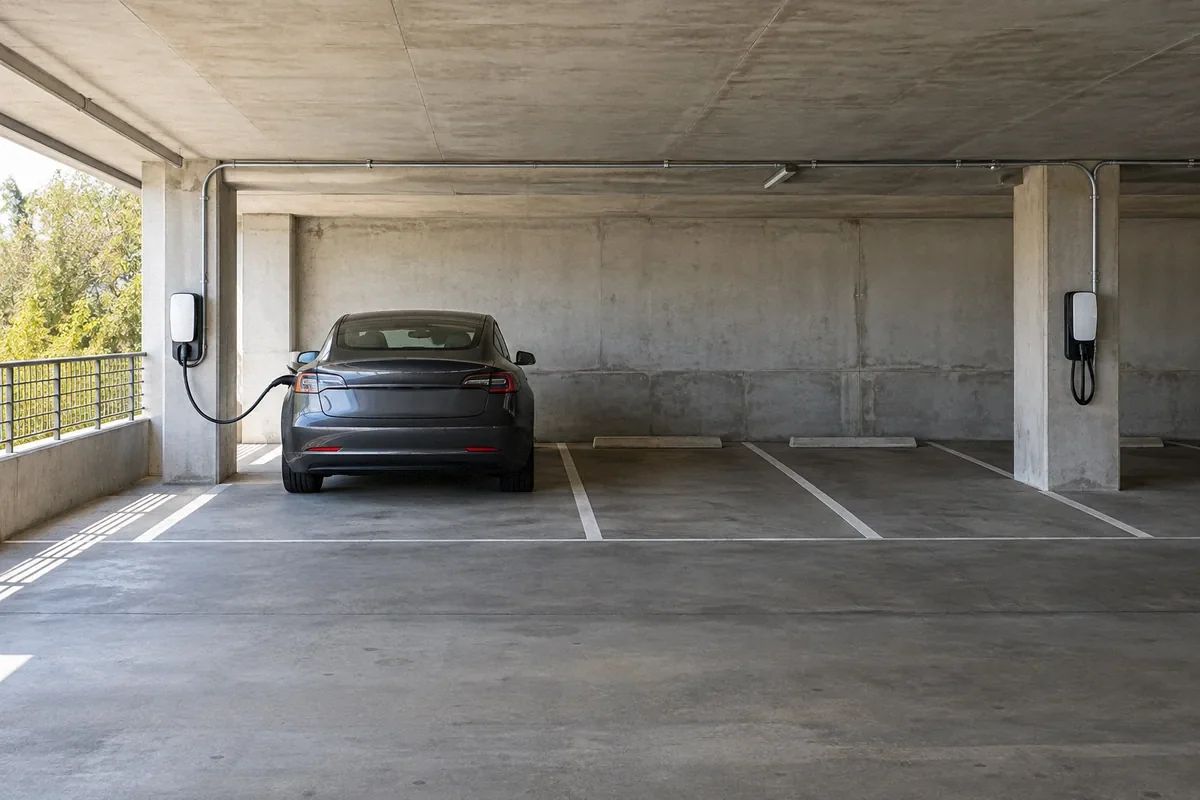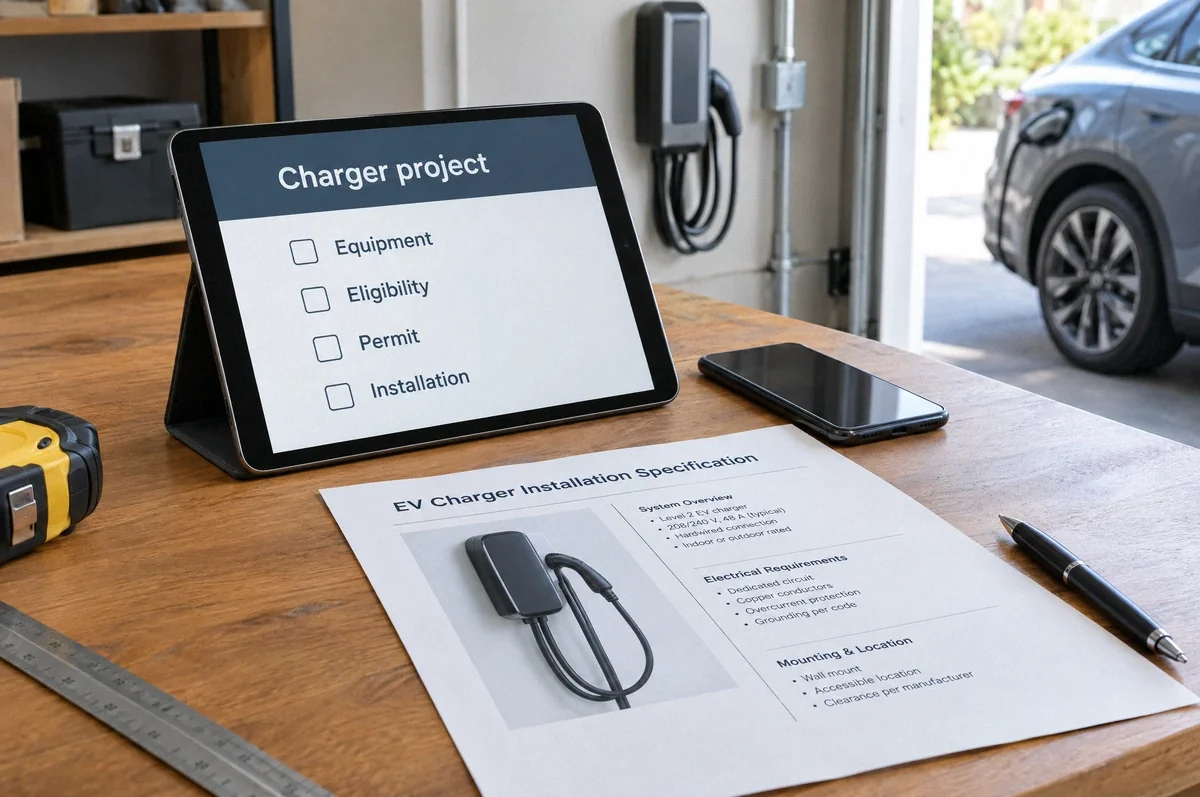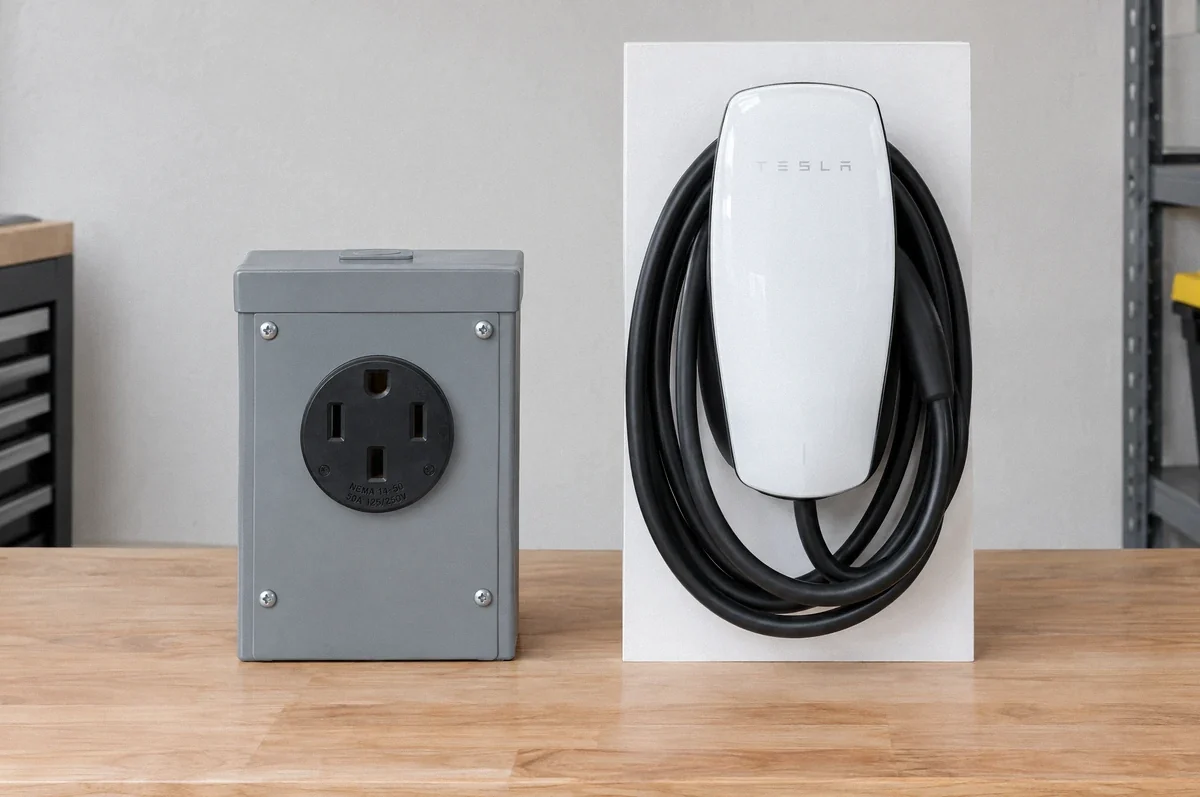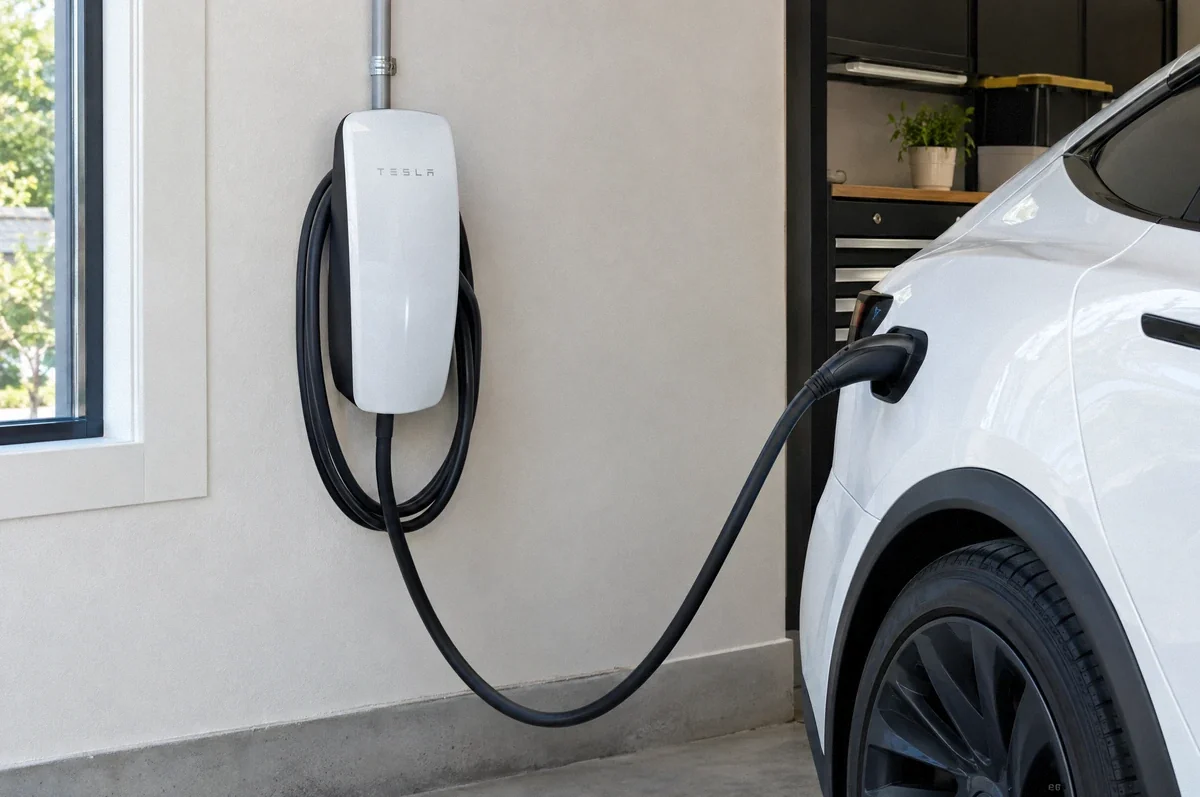
Tesla Wall Connector installation starts with the exact product, your vehicle’s charging limit, and the electrical capacity available at the parking location. The current Gen 3 Wall Connector is hardwired equipment. It is not a Mobile Connector fitted to an outlet, and adding a supply plug is not an alternative installation method to assume is permitted.
A 60-amp circuit can support the Wall Connector’s maximum 48-amp output when the rest of the installation and the vehicle support it. Lower configured outputs are also available. The appropriate circuit comes from the home’s assessment, rather than a rule that every Tesla needs the maximum setting.
Identify the model and the vehicle connector
Tesla sells different home charging products. Mobile Connector is portable equipment used with its approved adapters. Wall Connector is fixed charging equipment. Universal Wall Connector combines North American Charging Standard, or NACS, and J1772 connection capability. Those names describe vehicle connector interfaces; the exact car and equipment still need a compatibility check.
Tesla’s home charging comparison distinguishes these products. Confirm the connector and compatibility for your specific vehicle and model year. A new non-Tesla car might have a different inlet from an older vehicle of the same brand, and adapter suitability cannot be inferred from the brand name alone.
If you already own a unit, record its model and generation. Older Wall Connectors have different installation and power-sharing instructions. An online diagram for a previous generation or another country is not a substitute for the North American manual for your equipment.
Choose a charging rate you will actually use
The effective AC charging rate is limited by the circuit, the EVSE, and the vehicle. EVSE means electric vehicle supply equipment, the wall unit that controls power delivery. The vehicle’s onboard charger is another limit even when the wall equipment can supply more.
For common Gen 3 settings, the relationship is:
| Circuit rating | Maximum configured charging current |
|---|---|
| 20 amps | 16 amps |
| 30 amps | 24 amps |
| 40 amps | 32 amps |
| 50 amps | 40 amps |
| 60 amps | 48 amps |
Tesla publishes these relationships in its Wall Connector guidance. The table is a planning reference, not a conductor-selection or installation instruction. Breaker compatibility, conductor ratings, wiring method, terminals, and other site conditions still require design.
A driver who needs to replace a modest amount of energy overnight may gain little from increasing an otherwise adequate circuit. A driver with a short charging window may value higher output. Use actual driving and consumption records to compare those cases. Do not assume every vehicle will charge from nearly empty to full overnight.
The home charging planning guide explains daily-energy estimates. If you are comparing fixed and portable equipment, see Wall Connector versus NEMA 14-50.
Review the supply before buying circuit hardware
The electrician should assess the service, any feeder supplying the charging location, panel condition, compatible breaker positions, and calculated demand. A feeder is the circuit supplying another distribution panel. A large main service does not prove a detached-garage feeder can carry a new charger.
The panel’s condition and its capacity are separate findings. Likewise, an available breaker position does not prove there is spare power. A subpanel may improve distribution or provide spaces, but it does not enlarge the utility service.
If the proposed charging rate does not fit, compare a lower fixed configuration, a supported energy-management system, and any justified panel or service work. Our 100-amp panel and EV guide explains why a service upgrade is not automatic.
Distinguish the three power-management functions
Static management sets a fixed maximum appropriate to the installation. Dynamic management responds to measured demand. Group management shares a defined allocation among compatible charging units. The functions should be named in the proposal so you know what the installation actually controls.
Tesla’s power-management support page, checked September 13, 2026, says Dynamic Power Management needs a separately installed Tesla-approved meter and is currently available for single Gen 3 Wall Connector installations. Group Power Management supports up to six compatible Gen 3 units. Tesla does not describe the dynamic function as available across a group of multiple Wall Connectors.
That distinction matters for a two-car household. A fixed group allocation can keep the chargers within their assigned power without continuously measuring all household loads. A design must establish that allocation and the supply feeding it. It should not promise that two units will both charge at maximum speed whenever plugged in.
Ask how the system behaves when capacity is reduced, a vehicle finishes charging, or communication is interrupted. The final commissioning record should identify the installed control arrangement and limits.
One circuit or several for multiple Wall Connectors?
The answer depends on the exact equipment and approved design. Tesla’s Universal Wall Connector daisy-chain instructions allow a specified multiple-unit arrangement on one branch circuit. The manual requires group configuration, appropriate conductors, and a total limit; it says this daisy-chain arrangement is supported only on the Universal Wall Connector.
This can affect material and route planning, especially when several charging locations are far from the supply. It does not mean arbitrary chargers can share conductors or that a second unit can simply be attached to an existing circuit. The product-specific drawing and commissioning must be part of the project.
For a business or association planning many ports, the commercial and multifamily charging guide covers site demand, billing, and expansion decisions.
Check placement with the car parked
Identify the vehicle’s charging port and normal parking direction. The cable should reach without crossing stairs or a pedestrian route, rubbing a garage-door track, or being stretched tightly around the car. Consider where the handle will be stored when it is not connected.
Review the circuit route and mounting surface together. A finished garage wall, masonry wall, driveway pedestal, and detached structure create different installation work. Outdoor exposure, vehicle impact, conductor routing, voltage drop, and equipment access all influence the design.
A convenient charger location must also preserve electrical working space. Do not install storage or charging equipment where it obstructs access to a panel. The estimate should identify visible conduit, concealed wiring, penetrations, and restoration so the finished appearance is clear before work begins.
Permits, setup, and handover
New circuit and hardwired charger work generally requires a permit and inspection from the city or county responsible for the address. Utility involvement depends on service and metering scope. PG&E is one regional provider; municipal utilities serve some Bay Area addresses. The EV permit and incentive guide covers those separate steps.
The handover should include the installed model, circuit rating, configured charging limit, permit record, and demonstration of charging with the vehicle. Account registration, access controls, software status, and any power management should be checked as applicable. These are useful completion items, not substitutes for inspection.
Fox Electric can scope home EV charging electrical work around the selected Tesla equipment. Request an installation assessment with the product model, vehicle, and parking-location photos. Manufacturer certification or program participation, when required for a particular purchase or rebate, must be confirmed separately.