CSLB #1145945 — Licensed C-10 Electrical Contractor
(650) 550-0719
GFCI vs. AFCI: What California Code Requires at Home
Safety & Code June 14, 2026 7 min read By Serge Fox, Licensed C-10 Electrician

GFCI vs. AFCI: What California Code Requires at Home

GFCI and AFCI protection do two different jobs, and California code requires both in specific places. Here is what each one protects against, where the code mandates them, and how to tell what your home is missing.

F

Fox Electric Team

Licensed C-10 Contractor

People mix these two up constantly, and it's understandable — both are safety devices, both can live in your panel or your outlets, and both have a "TEST" and "RESET" button. But they do completely different jobs. GFCI protection is about people. AFCI protection is about fire. One watches for electricity escaping to ground through a human body; the other watches for the kind of sparking inside a wall that starts a fire at 2 a.m. California code requires both, in different parts of the house, and knowing which is which tells you a lot about whether your home is actually protected. Here's the plain-English version, plus where California code generally requires each.

The One-Sentence Difference

GFCI (Ground Fault Circuit Interrupter) protects you from electric shock. It constantly compares the current going out on the hot wire against the current coming back on the neutral. If even a tiny amount — about 5 milliamps — goes missing, that current is leaking somewhere it shouldn't, often through water, a tool, or a person. The GFCI cuts power in a fraction of a second, fast enough to prevent a fatal shock.

AFCI (Arc Fault Circuit Interrupter) protects your house from fire. It listens for the electrical "signature" of a dangerous arc — the sputtering, sparking discharge that happens when a wire is damaged, a connection is loose, or a nail gets driven through a cable behind drywall. Normal arcing happens every time a switch flips or a motor starts, so an AFCI has to be smart enough to tell harmless arcs from the ones that ignite wood and insulation. When it detects the dangerous kind, it shuts the circuit down.

So: GFCI = anti-shock, watches for leakage to ground. AFCI = anti-fire, watches for arcing. Different threat, different device.

Where California Code Requires GFCI

The California Electrical Code is based on the National Electrical Code (NEC), and it has steadily expanded GFCI requirements over the years. The logic is simple: anywhere water and electricity can meet, you need shock protection. Current California code generally requires GFCI protection at receptacles in:

  • Kitchens — countertop outlets serving the work surfaces
  • Bathrooms — all receptacles
  • Garages and accessory buildings
  • Outdoors — patios, decks, exterior walls
  • Laundry areas and near utility/wet-bar sinks
  • Crawl spaces, unfinished basements, and similar damp locations
  • Pools, spas, and hot tubs — these have their own strict GFCI rules

Newer code cycles have pushed GFCI into even more places, including some appliance circuits. Because the exact list shifts with each code update, the honest answer is: current California code requires GFCI in all the wet and outdoor areas above, and the list keeps growing. For a specific remodel or new circuit, confirm the requirement with your local building inspector or a licensed electrician, since what your city enforces depends on the code cycle in effect when you pull the permit.

Where California Code Requires AFCI

California was actually ahead of the curve here. The state has required AFCI protection on bedroom circuits since around 2008, and broader living-area coverage came in with later code cycles (the 2014 update was a big expansion). Today, current California code generally requires AFCI protection on most circuits serving living areas, including:

  • Bedrooms
  • Living rooms and family rooms
  • Dining rooms
  • Hallways, closets, and dens
  • Most other habitable-room circuits

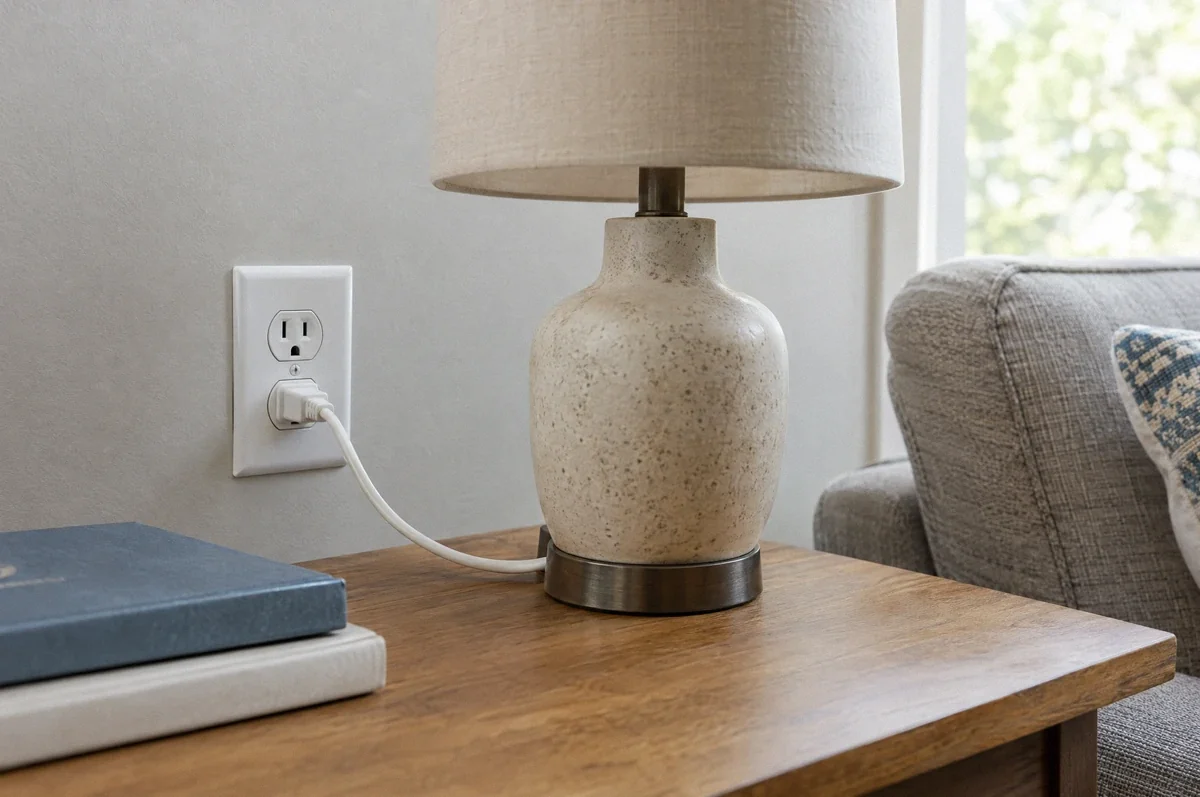
The reasoning: these are the rooms full of lamp cords, phone chargers, furniture pressed against outlets, and decades-old wiring inside the walls — exactly where a loose connection or a pinched cable can quietly arc for months before it ignites. AFCI protection is the only device designed to catch that.

What About Both at Once? Dual-Function Devices

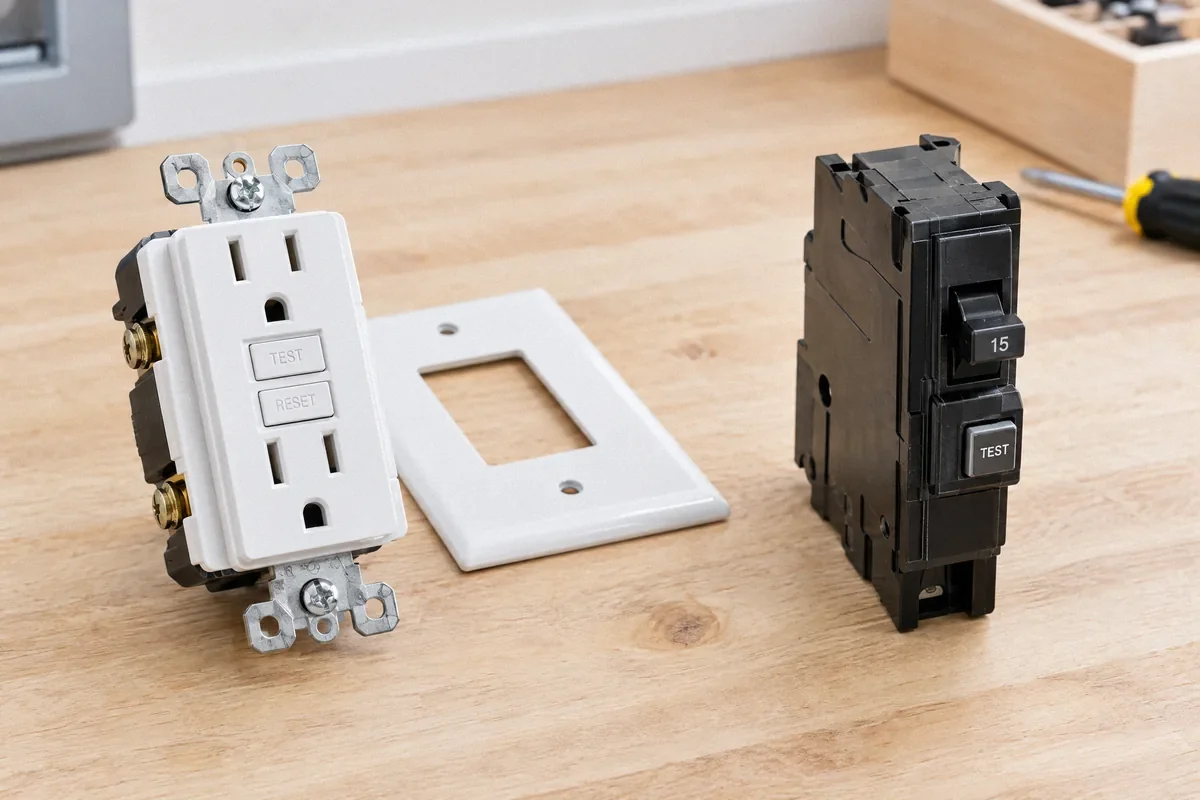
Plenty of locations need both shock protection and fire protection — a kitchen, for example, is both a wet area (GFCI) and a living-area circuit (AFCI). That's where dual-function devices come in. A DFCI (dual-function) breaker or outlet combines GFCI and AFCI in a single unit, so one device satisfies both requirements.

This is why modern panels in newer California homes are full of expensive breakers. A standard breaker might cost a few dollars; a combination AFCI/GFCI breaker can run $40-60 or more each. Multiply that across a whole panel and you understand why a code-compliant panel costs what it does. It's not an upsell — it's the code doing its job.

How to Tell What You Already Have

You don't need a meter to take inventory. Here's how to read your own house:

Look at your outlets

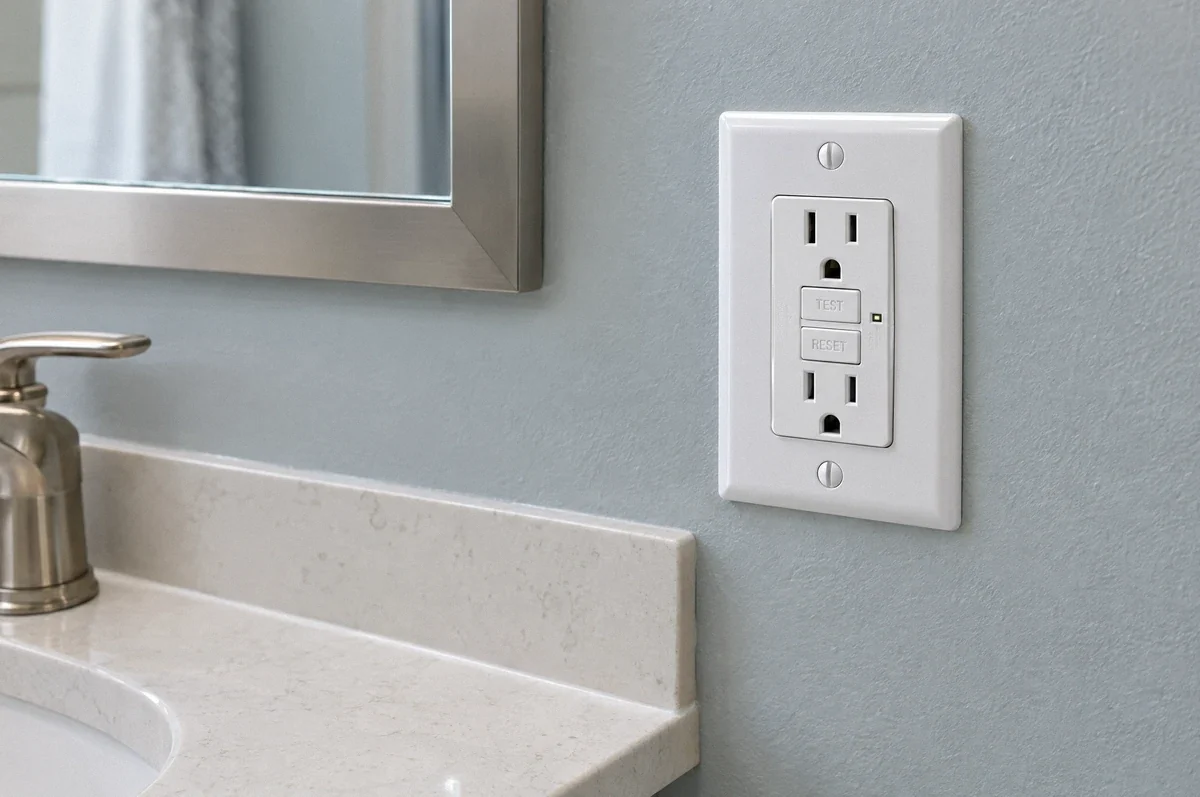
How to tell: A GFCI outlet has two small buttons in the center, usually marked TEST and RESET. Press TEST and the outlet should click and cut power; press RESET to restore it. If your kitchen, bathroom, garage, or outdoor outlets have those buttons, you have GFCI protection there. Note that one GFCI outlet often protects several "downstream" plain outlets on the same circuit, so not every protected outlet has the buttons.

Look at your breaker panel

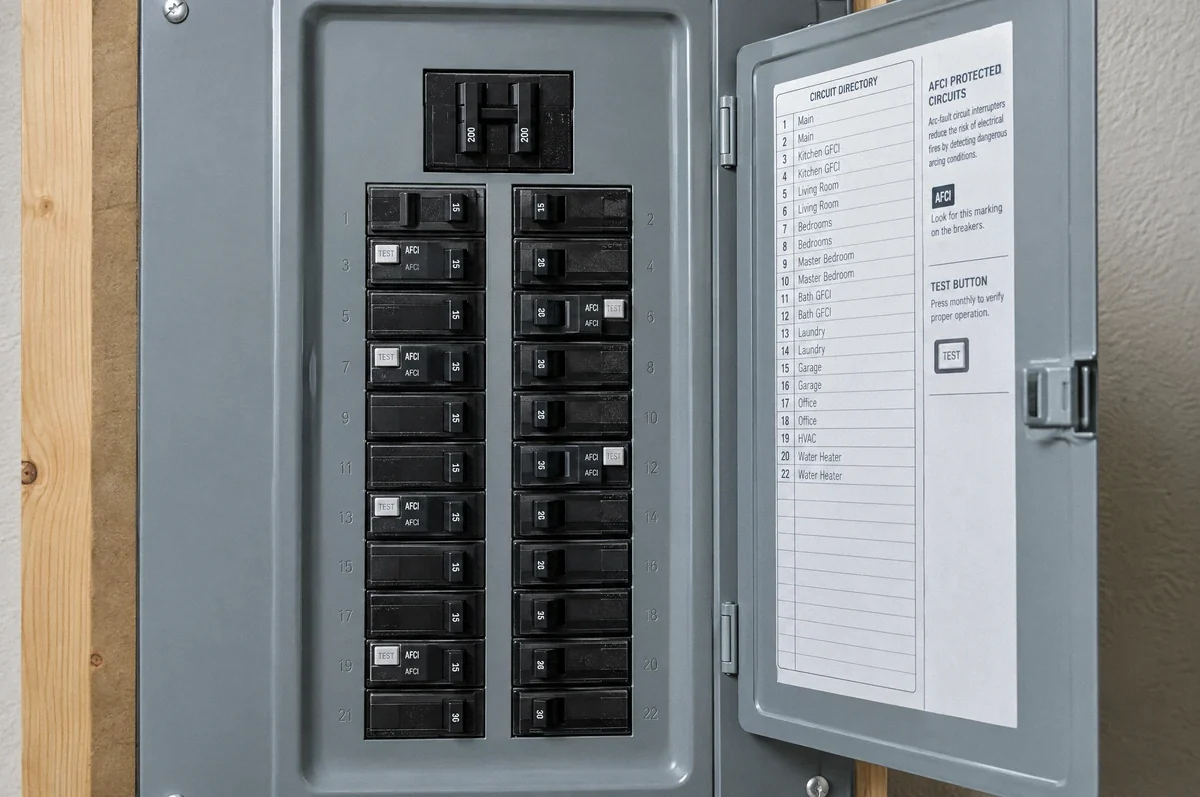
How to tell: Open the panel door and look at the breakers themselves. GFCI, AFCI, and dual-function breakers have a little TEST button right on the breaker and usually a printed label — you'll see stamps like "GFCI," "AFCI," "CAFCI" (combination AFCI), or "DUAL FUNCTION." Plain breakers have no test button and no such marking. If you see a row of breakers with test buttons, your home has modern circuit protection. If the panel is all plain breakers, your protection (if any) lives at the outlets instead.

What to do: Test your GFCIs monthly. Press TEST, confirm power cuts, press RESET. A GFCI that won't trip when you test it has failed and is no longer protecting you — that's a same-day replacement, and it's a small job. (More on our outlet and switch work below.)

Nuisance Tripping: What It Actually Means

The most common complaint we hear about AFCI breakers is "it keeps tripping for no reason." Sometimes it's a genuinely oversensitive older AFCI reacting to a vacuum motor or a cheap power supply. But far more often, the breaker is doing exactly what it was built to do — it found real arcing somewhere on the circuit.

What to do: Don't assume a tripping AFCI is "just being annoying." A loose backstabbed connection in an outlet, a damaged cord, or a nicked cable behind the wall will all trip an AFCI, and those are real fire hazards. The same goes for a GFCI that trips repeatedly outdoors after rain — it's telling you moisture is getting into a box or fixture. We walk through this in detail in our guide on why breakers keep tripping, but the short version is: a tripping safety device is information, not a malfunction. Resetting it over and over without finding the cause defeats the entire point of having it.

Older Homes: When You Need a Retrofit

If your house was built before these requirements existed, you are generally not forced to tear out the walls and rewire just to add AFCI everywhere. Code is mostly forward-looking. But there are clear trigger points where retrofitting becomes required or strongly recommended:

  1. During a permitted remodel. When you pull a permit and open up circuits — a kitchen remodel, a bedroom addition, a new bathroom — the work you touch typically has to be brought up to current code, which usually means adding GFCI and/or AFCI protection on those circuits.
  2. When you replace a panel. A panel upgrade is the natural moment to add modern AFCI/GFCI/dual-function breakers, because you're installing new breakers anyway. This is the cleanest way to get whole-home protection.
  3. When you replace a failed or missing GFCI. Swapping a dead GFCI outlet, or adding one where a wet location currently has none, is a small, affordable job — the device itself is roughly a $20-30 part, plus labor.
  4. When a safety inspection flags a gap. If you're buying or selling, or you just want peace of mind, a safety inspection will document exactly which areas lack required protection so you can prioritize.

On cost: a single GFCI outlet replacement is one of the least expensive electrical jobs there is. Adding individual AFCI or dual-function breakers costs more per device because the breakers themselves are expensive. A full whole-panel AFCI retrofit — where every living-area circuit gets a combination breaker — is a bigger job, both in parts and labor, and is usually done as part of a panel upgrade rather than on its own. We can't quote a real number without seeing your panel and circuit layout, so treat any "flat price" you see online with suspicion. The right approach is a quick look at your panel and an honest estimate based on what's actually there.

The Bottom Line for California Homeowners

Remember the split: GFCI saves lives in wet areas; AFCI prevents fires in living areas; dual-function does both. Walk your house once, look for the TEST/RESET buttons on outlets and the stamps on your breakers, and you'll know roughly where you stand. If your kitchen and bathroom outlets have GFCI buttons and your panel has a row of breakers with test buttons, you're in good shape. If you've got an all-plain panel in a home built before the mid-2000s, you're likely missing AFCI protection in your bedrooms and living spaces — worth addressing, especially if a remodel or panel upgrade is already on the horizon.

Call Fox Electric

We install and troubleshoot GFCI, AFCI, and dual-function protection across San Mateo and Santa Clara counties. Whether it's a single dead GFCI outlet, a stubborn AFCI breaker that keeps tripping, or a full code-compliant panel upgrade, we'll tell you exactly what your home has, what California code requires for your situation, and what it actually costs — no guesswork, no scare tactics.

Call (650) 550-0719 to schedule a visit. We'll read your panel, test your devices, and give you a straight answer about where you're protected and where you're not.

Need a Pro?

Talk to a licensed electrician.

Free on-site estimate with a fixed-price quote — no obligation. We respond within 2 hours during business hours.

Call Email