An AFCI breaker that keeps tripping may be responding to damaged wiring, an appliance fault, an installation problem, or a condition requiring manufacturer-specific troubleshooting. The absence of smoke or a visible spark does not establish that the trip is a nuisance. Start by identifying which protective device operated and recording what was happening, then have a recurring problem diagnosed.
Do not substitute a standard breaker, install a larger breaker, or defeat protection to keep the circuit running. If there is heat, a burning smell, visible damage, or crackling, leave the circuit off if it is already off. Stay away from suspect equipment and arrange urgent help. Leave the area and call 911 for smoke, fire, active arcing, or a suspected developing fire.
AFCI, GFCI, and combination are different terms
An arc-fault circuit interrupter, or AFCI, detects characteristics of certain hazardous electrical arcs. An arc is an electrical discharge across a gap or damaged connection. The device is intended to reduce the likelihood that arcing becomes an ignition source.
A ground-fault circuit interrupter, or GFCI, detects current taking an unintended return path and reduces ground-fault shock risk. A dual-function AFCI/GFCI breaker provides both forms of protection along with its normal overcurrent function. By contrast, a combination-type AFCI refers to protection against both series and parallel arcing. The word combination does not by itself mean GFCI protection. Leviton’s protection-device guidance explains this terminology.
This distinction changes diagnosis. A dual-function breaker can trip because of leakage current even if no arc is present. An AFCI breaker can also trip on an overload or short circuit. A TEST button alone does not identify the trip reason.
If the device interrupting power is a receptacle with TEST and RESET buttons, read its face marking to identify GFCI, AFCI, or dual-function protection. AFCI receptacles also have these controls. For a GFCI receptacle, see why a GFCI keeps tripping.
The pattern helps narrow the investigation
The most useful description includes the timing, the affected circuit, and the equipment operating at the time. For example, “the bedroom circuit tripped when the vacuum started” is more informative than “the breaker is too sensitive.” It preserves the observation without deciding its cause.
Different patterns lead to different questions:
- A trip as a particular appliance starts can point toward the appliance, its cord, the receptacle connection, or an interaction that needs investigation.
- A trip after several high-load appliances run together raises a question about circuit loading, in addition to possible faults.
- A trip following a new light fixture, dimmer, or remodel calls for review of the changed equipment and connections.
- A trip with accessible plug-in loads removed leaves fixed lighting, hidden connected equipment, wiring, and the breaker itself among the possibilities.
- A recurring event affecting several circuits can require a broader supply or installation investigation.
Do not create these patterns by deliberately repeating a fault. Record the circumstances of events that already occurred. A brief video of a visible indicator may help, provided it can be taken without approaching damaged equipment.
Why a motor or electronic device is not automatically the culprit
Motors and electronics can complicate arc-fault diagnosis, but “the vacuum trips it” does not prove that harmless electrical noise fooled the breaker. A worn cord, failing motor, damaged receptacle, or loose connection can produce the same outward result.
If one device was involved, turn it off and leave it unplugged when safe. Do not move it around the house to see how many different circuits it trips. An appliance that behaves differently on another circuit has not passed a safety test.
An electrician may use the breaker manufacturer’s diagnostic process and coordinate with the appliance manufacturer when appropriate. Sometimes a product fault or compatibility issue is established. That conclusion should follow evidence rather than an assumption about cheap chargers or older breakers.
A dedicated circuit can address a verified load or installation requirement. It cannot repair an appliance fault or make damaged wiring acceptable.
Shared neutrals need careful identification
A neutral is the normal return conductor for a typical 120-volt circuit. Some properly designed multiwire branch circuits use two hot conductors sharing a neutral. That arrangement is not automatically a wiring error. Protection, disconnecting means, and conductor connections must suit the circuit.
A problem arises when the breaker arrangement does not support the shared neutral, or when neutrals from unrelated circuits have been interconnected incorrectly. Schneider Electric’s current guidance says that the specified single-pole AFCI and GFCI breaker families cannot serve two circuits with a shared neutral in that arrangement. It describes appropriate two-pole alternatives subject to the installation and local code. This is product-specific guidance, not permission to choose a replacement breaker by appearance.
Do not disconnect neutrals or combine grounding and neutral conductors to experiment. Incorrect neutral work can energize equipment or create damaging voltage conditions. Circuit tracing and equipment selection belong in a professional diagnosis.
What a homeowner can do with covers in place
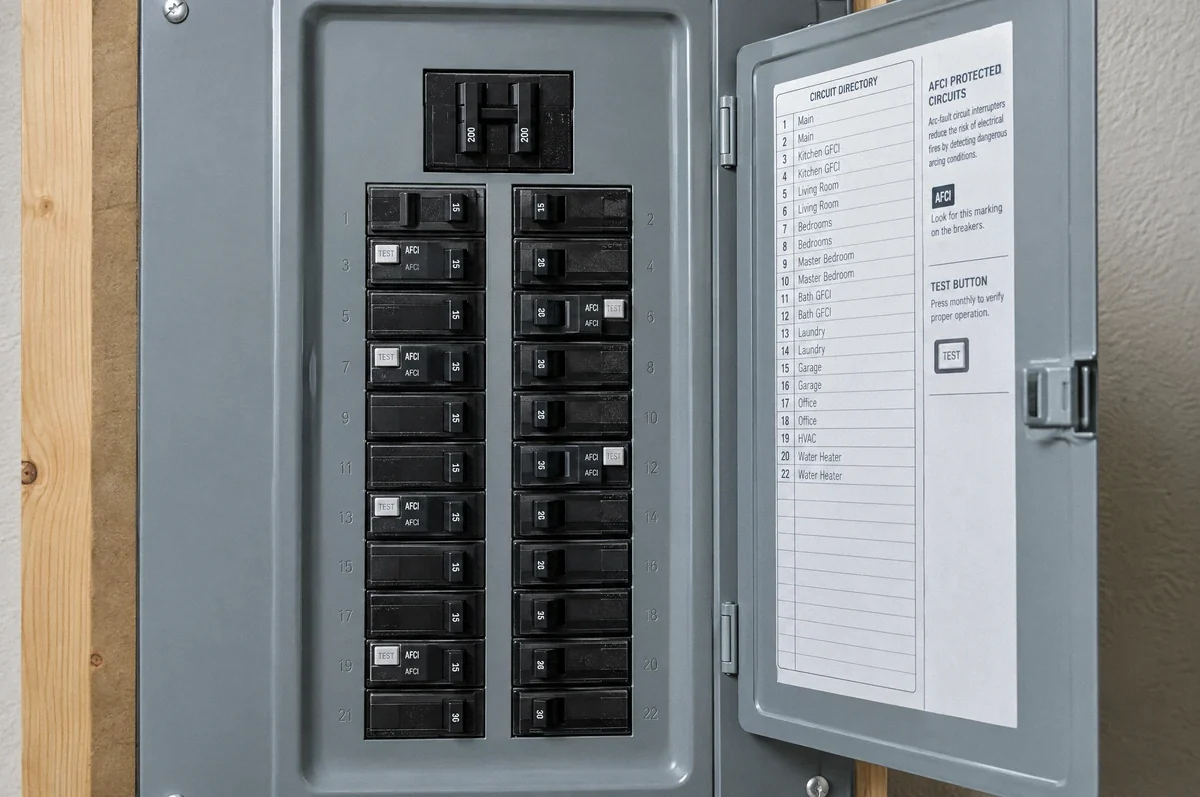
Where the panel is dry, intact, safely accessible, and free of heat, odor, noise, damage, or exposed parts, you may read visible labels and the circuit directory. The hinged outer door may be opened to reach normal controls; the screwed protective cover stays installed. Do not open any compartment that exposes wiring.
After accessible loads are switched off and unplugged, a single reset may be reasonable if there was an apparent overload and no other warning sign. Follow the device’s instructions. Do not repeatedly cycle the breaker. If the cause is unknown, it trips again, or the handle will not operate normally, leave the affected circuit off and arrange service.
Read a visible trip indicator only according to the exact model’s documentation. Indicator colors and flash counts vary. Some breakers store or clear diagnostic information under specific conditions. Eaton’s residential breaker instructions demonstrate why a generic internet flash-code list is unreliable.
Do not open the panel to find an otherwise hidden model number. A photo of the intact front is sufficient for the initial discussion.
What the electrician should establish
A useful electrical troubleshooting visit should distinguish the protection type from the trip cause and identify the limits of the investigation. Depending on the symptoms, the work may include checking the connected load, mapping the circuit, reviewing neutral arrangements, inspecting accessible connections after isolation, and evaluating the condition and suitability of the breaker.
An intermittent fault may not occur during the visit. Ask which observations support the proposed repair and what would happen if the symptom returns. “Could not reproduce” is different from “no fault exists.”
For older wiring, an electrical safety inspection may be appropriate if the investigation finds deterioration beyond one device. That is a separate scope decision, not an automatic whole-house rewire.
Does a panel change require AFCI everywhere?
AFCI requirements depend on the adopted code, the circuits involved, and whether the work is a replacement, extension, alteration, or new installation. A panel replacement does not justify a blanket statement that every existing circuit must receive identical protection.
California’s 2025 Building Standards Code became effective January 1, 2026. The actual permit authority applies the requirements to the proposed work and any local amendments. Use the California Building Standards Commission’s code information as the starting point, then have the contractor identify what the project requires.
Request a diagnosis with useful details
Fox Electric can assess recurring AFCI trips in Bay Area homes and the city of Santa Cruz. Send the circuit label, device involved, and timing of the trip, along with a photo of the intact breaker front if safely available. If trips accompany flickering, unusual brightening, heat, or an odor, include that information and review our electrical warning signs guide.