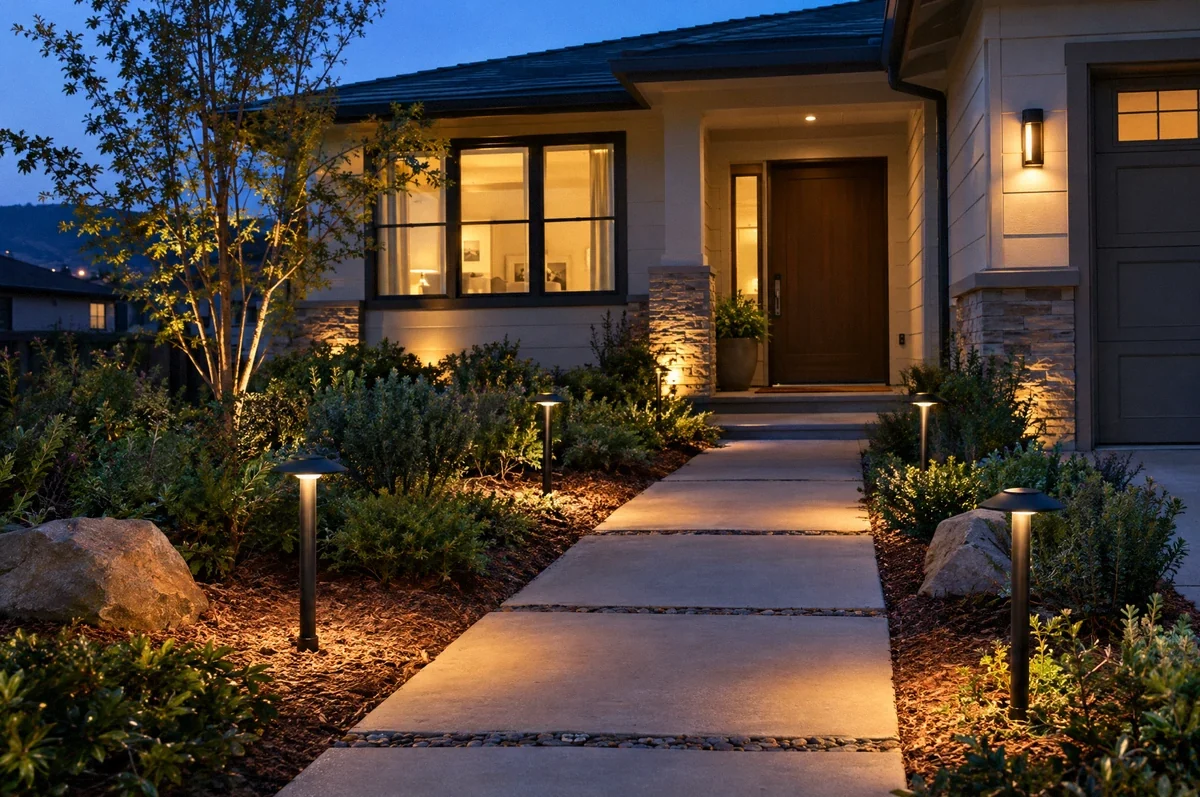
Outdoor lighting should help people use the property after dark without creating uncomfortable glare. Start with the steps, paths, entries, and work areas that need light. Then decide whether accent lighting has a useful role and how each group should be controlled.
The electrical design depends on the equipment. A low-voltage landscape system, a hardwired porch fixture, and a floodlight camera do not have identical power or installation requirements. Treat them as coordinated parts of the property rather than assuming one cable and one timer will serve everything.
Walk the property after dark
Look at the property from the street, the front door, and the usual approach to the house. Identify steps that disappear into shadow, uneven paving, and places where an existing bright fixture shines directly into someone’s eyes.
Also look outward from bedroom and living-room windows. A light that looks attractive from the driveway may be distracting indoors. Consider neighboring windows and the view from a driver approaching the property.
Separate practical tasks from decoration. A gate needs enough light to operate the latch. A stair needs its changes in level to be visible. A seating area may need a soft background and a separate task light. Brighter light everywhere is not necessarily the most useful response.
For a larger project, record the locations on a plan and assign a purpose to each fixture. That makes it easier to compare estimates and remove lights that add glare without solving a problem.
Low voltage describes the supply, not the energy savings
Many landscape systems use a transformer to reduce household supply voltage for compatible fixtures. The transformer, cable, connections, and lights must work as a system. Low voltage does not mean the installation is maintenance-free or that any cable can be buried anywhere.
Energy use depends on the actual equipment wattage and operating hours. A lower supply voltage alone does not establish lower energy consumption. LED fixtures can reduce power use compared with suitable older alternatives, but the saving must be calculated from the actual replacement and schedule.
Kichler’s landscape load-planning guidance considers connected fixture load and voltage drop along each run. Voltage drop is the reduction in voltage as current travels through the cable. A long run and its load can affect the cable and transformer arrangement.
That is why adding several lights to an existing system needs a review of the whole run. An unused transformer terminal or an open patch of garden is not proof of spare electrical capacity.
Match the equipment to its exposure
Describe where the fixture will be installed, not simply that it is “outside.” A sheltered porch, an exposed garden path, and a location reached by irrigation present different conditions. Fog, coastal air, drainage, and the possibility of standing water also matter.
A wet-location rating, a corrosion-resistant finish, and protection for a receptacle are different features. Check the fixture, transformer, connectors, enclosure, and installation instructions for their specific uses. For example, Kichler identifies its 15E60BK transformer as a wet-rated product with a defined operating range; those properties cannot be assumed for an indoor power supply.
The installer should determine the required protection, routing, mounting, and clearances for the equipment and local rules. Pool and spa areas need a separate assessment because ordinary landscape-lighting assumptions may not apply.
If the project includes a new outdoor receptacle, review that work through the outlet and switch service. Ground-fault circuit-interrupter protection, often called GFCI, is part of many outdoor applications and must be considered with the actual circuit.
Plan the route before planting or paving
Cable routing can drive the scope more than the number of fixtures. A route through an accessible planting bed differs from one under an existing driveway, patio, retaining wall, or finished slab.
Coordinate electrical work with irrigation, drainage, and planned landscaping. Identify where fixtures might be moved by mowing, gardening, or future planting. Place connection points and equipment where they can be maintained by the appropriate method.
Discuss whether the estimate includes excavation, crossings, restoration, and locating other utilities. Do not assume every landscape cable has the same burial requirement; the wiring method, supply, location, and applicable rules determine it.
If future additions are likely, identify them now. A planned route or suitable spare pathway may be useful. Buying an oversized transformer without a plan does not resolve a difficult route or incompatible fixtures.
Give the controls a clear job
Different lighting groups may need different schedules. Path lighting might run during evening use, a porch light may respond to occupancy, and decorative lighting may turn off earlier. Decide which controls should remain easy to operate manually.
A photocell responds to ambient light. A timer follows a schedule. A motion sensor responds to detected movement. Smart controls may combine schedules and remote operation, but their network and equipment requirements vary.
Check the intended behavior during an internet outage and after power returns. An automatic schedule should not leave a necessary route unusable when someone needs it outside the usual hours. The smart lighting guide explains how physical controls and connected features differ.
For a camera with integrated lighting, settle the electrical and device scope together. Camera power, recording, and app setup are covered in security-camera wiring planning.
What changes the estimate
Ask the scope to identify fixture models or allowances, the power source, transformer arrangement if applicable, cable routes, controls, and the planned restoration. It should state whether nighttime aiming and adjustment are included.
A replacement using a suitable existing route may be a smaller project than adding a new circuit across finished hardscape. Corroded connections, inadequate protection, or an incompatible old transformer can also change the work. Assess those conditions before committing to reuse equipment.
Seasonal decorative lighting is a different scope from a permanent landscape installation. If that is the goal, use the holiday lighting service to discuss equipment, access, timing, and removal.
Review the result at night
After installation, check the same routes used during planning. Look for glare at eye level, uneven steps, light spilling into windows, and fixtures aimed away from their intended surface. Review timer settings and manual overrides with the installer.
Keep the fixture models, lamp information, transformer details, and a simple route record. These make later maintenance and landscaping changes easier to plan.
Contact Fox Electric with photographs, a rough site plan, and the areas you want to use after dark. Our lighting installation service can assess the electrical work and define an appropriate scope.