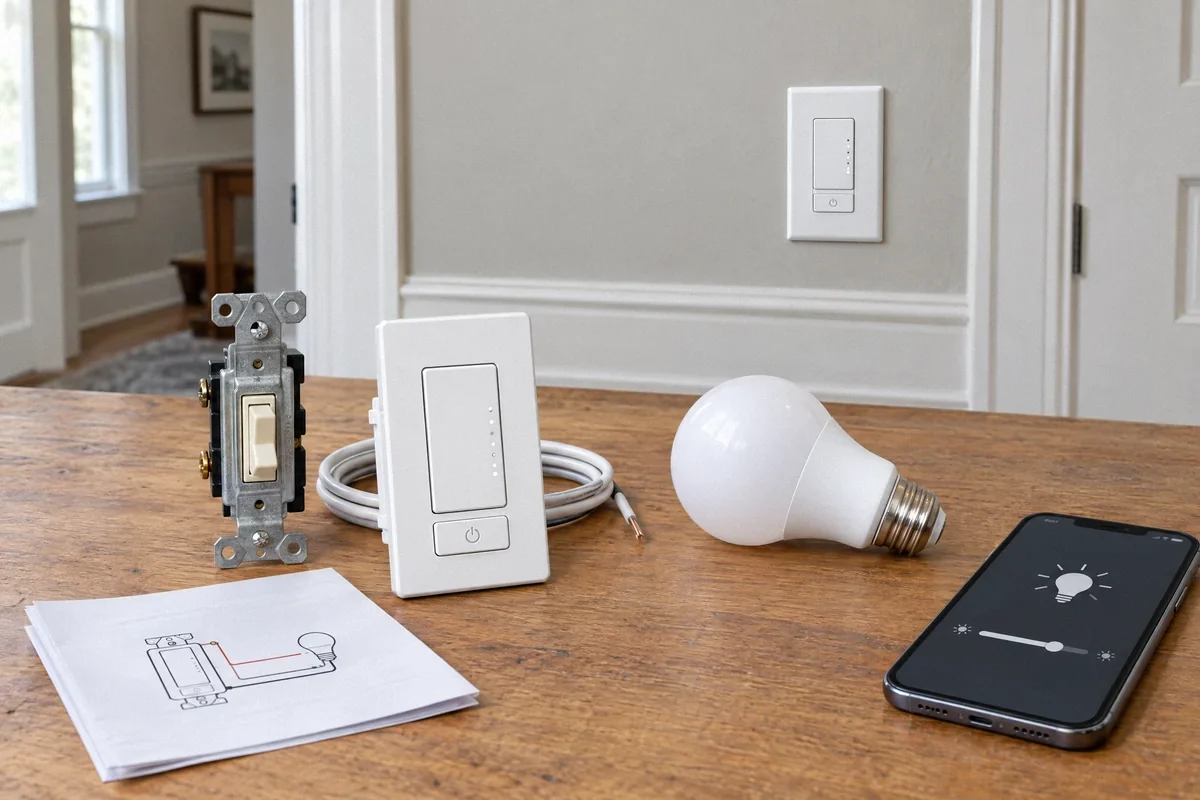
Smart bulbs, smart switches, and smart dimmers solve different lighting problems. Smart bulbs can offer individual lamp control and, on supported models, adjustable color. A smart switch controls a connected load on and off. A smart dimmer also adjusts the brightness of compatible lighting.
The useful starting question is what should happen in the room. Do you want familiar wall controls, a schedule for exterior lights, warmer evening light, or one button that changes several groups? Choose the functions first, then verify the equipment and wiring needed to deliver them.
Decide where the intelligence belongs
A smart bulb contains its own control electronics. It needs the appropriate power supply and a supported communication method to respond. Switching off its supply at an ordinary wall switch can make it unavailable to the app or automation. That can be inconvenient in a room where guests naturally reach for the switch.
A smart wall control instead operates the connected lighting circuit. This can be useful for a group of compatible ceiling lights that should always behave together. It does not automatically give an ordinary white LED bulb the ability to change color.
| Your main goal | A starting option to evaluate |
|---|---|
| Individual lamp colors or scenes | Compatible smart bulbs and their supported physical controls |
| Familiar on/off control of a lighting group | A smart switch rated for that load |
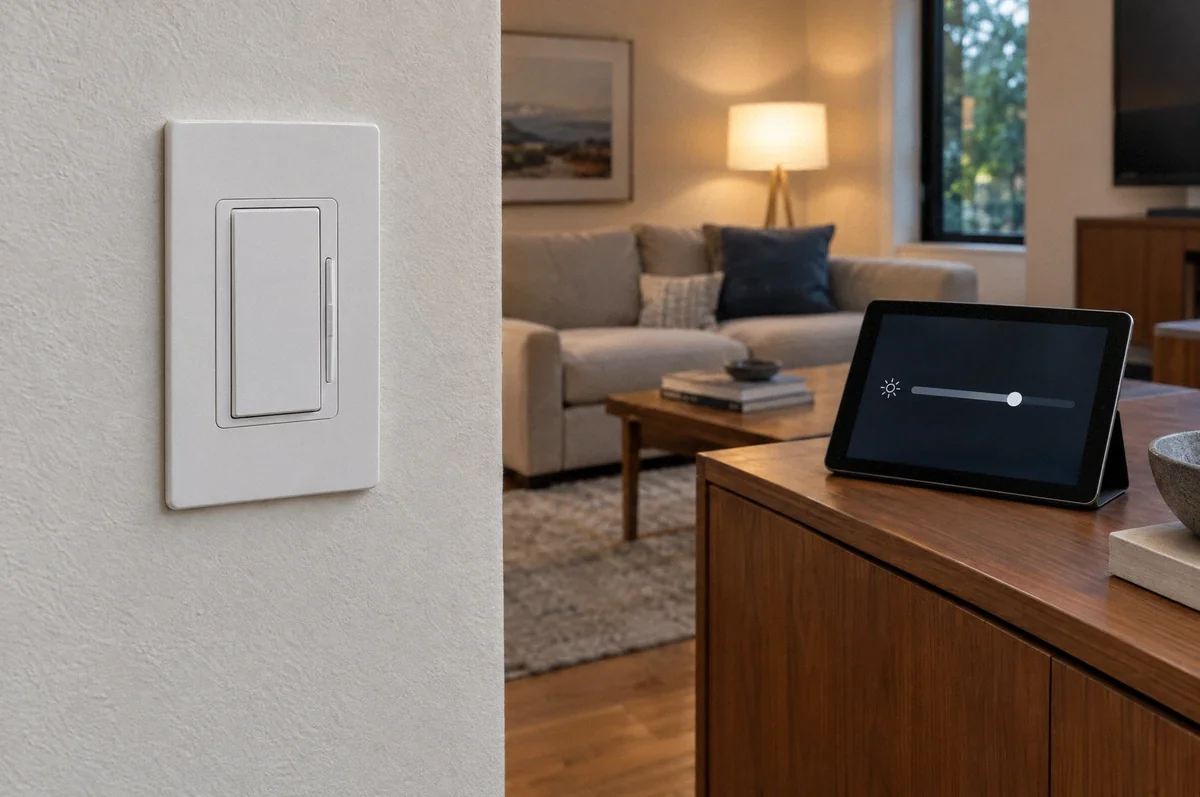
| Dimming several ceiling lights together | A compatible smart dimmer and dimmable lamps or drivers |
| Adding another control position | A supported wired accessory or wireless remote |
| Coordinating multiple rooms and devices | A system with the needed integrations and an agreed programming scope |
These are planning options, not universal prescriptions. A mixed system may fit the house if its operation remains understandable.
A smart bulb is not an ordinary dimmable bulb
Do not assume a conventional wall dimmer can safely or reliably control a smart bulb. The bulb may expect a continuous supply and perform dimming electronically inside the lamp. Philips Hue’s dimming explanation distinguishes its integrated dimming from traditional LED dimmer arrangements. Follow the exact lamp and control instructions for the proposed combination.
For ordinary LEDs on a smart dimmer, the dimmer still needs to match the lamp or driver. “Smart” does not remove compatibility problems. Confirm the supported load type, minimum and maximum load, fixture count, and dimming method.
An LED driver is the component that supplies power to the LED at the conditions it needs. Different drivers may require different controls. A product name or the appearance of a paddle switch is not enough to make that choice.
Choose by the way the room is used
In a living room with floor lamps, smart bulbs can provide individual settings without replacing every wall control. That is useful when one lamp should support reading while another supplies background light. Decide how someone will operate each lamp physically; an app-only arrangement may be awkward for guests or family members.
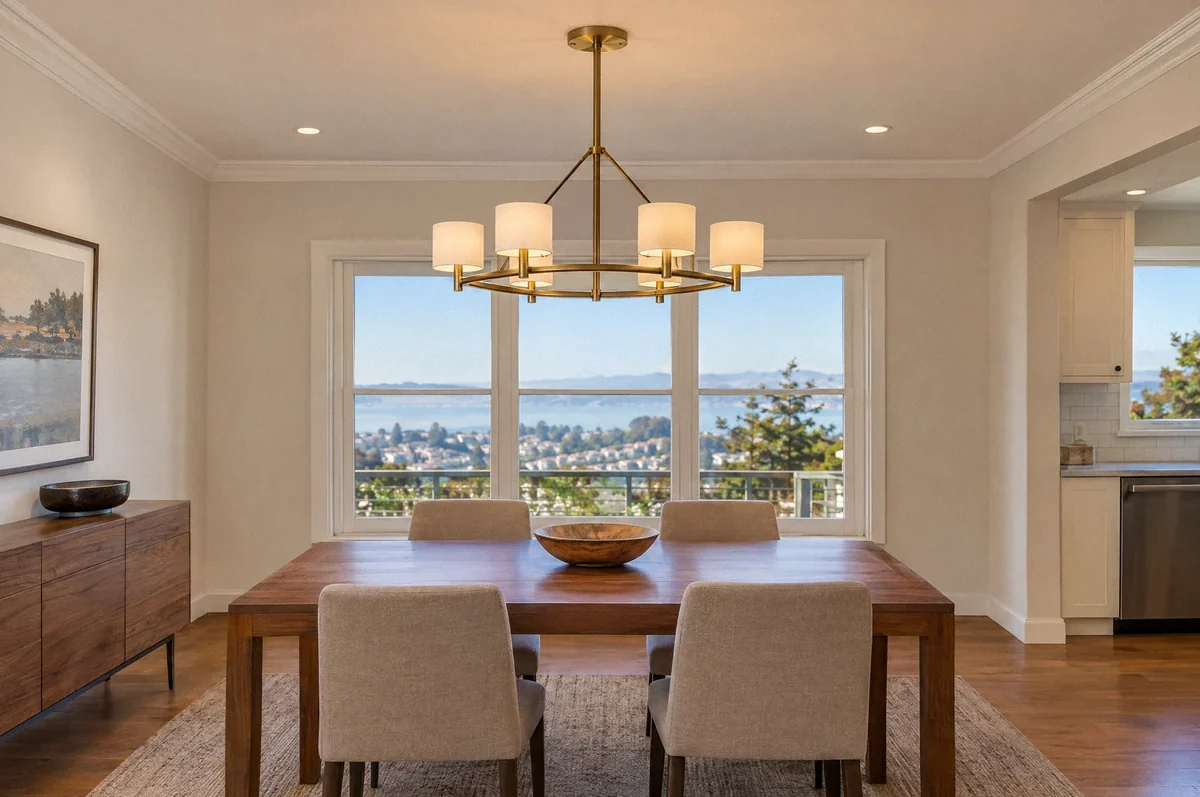
For a dining room with several ordinary dimmable lamps in one chandelier, a compatible wall dimmer can provide one familiar control for the group. If you want each lamp to show a different color, that is a different equipment decision. Dimming the circuit does not add color-changing capability to the lamps.
In a kitchen, work lighting and evening lighting may need separate groups. A smart switch can automate an on/off group, while a dimmer can adjust a compatible group over a useful range. If the desired separation does not exist in the wiring, changing the switch alone will not create independently controlled circuits.
For a hallway, the priority may be dependable operation at both ends. In that case, physical control locations and predictable brightness can matter more than elaborate scenes. Use the three-way and four-way switch guide to plan supported additional locations.
A bedroom may benefit from a bedside control and a simple low-light setting. Consider what should happen when someone operates the doorway switch, when a scheduled scene starts, and when another household member changes the brightness. A system that repeatedly overrides people can be more frustrating than the ordinary controls it replaced.
Compare the cost of the complete arrangement
Compare a room’s finished system, not just the price of one bulb or switch. A group with many replaceable lamps may require many smart bulbs, while one compatible wall dimmer might control the whole group. Conversely, a pair of lamps may be a modest smart-bulb project when no wall-wiring change is needed.
Include accessories, hubs where required, mounting, electrical work, setup, and replacement parts. Think about how the system will be maintained if a lamp fails or a fixture changes. A household should not need to rediscover the entire design every time it buys a replacement bulb.
Keep the product model numbers together with a short description of the intended room behavior. That helps preserve compatibility when equipment is replaced.
Verify wiring before committing to wall controls
A neutral is the circuit conductor that normally carries current back from connected equipment. Some controls need it at the wall box; some supported applications do not. Lutron’s Diva smart dimmer DVRF-6L does not require a neutral, while the Claro smart switch DVRF-5NS does. Appearance and house age cannot resolve that choice.
Have the actual wiring, load, and box space assessed. Do not use a grounding conductor as a neutral. The detailed pre-purchase checks belong in smart switch installation planning; use them once you know which functions the room needs.
Decide what should happen without the app
Ask the system provider to distinguish physical control, local remotes, schedules, phone access, and voice integrations. Confirm which depend on internet, a hub, or another service. Different communication systems have different requirements; a hub is neither a universal requirement nor proof of reliability.
Use a short behavior list when comparing options: guests can turn on the room light, bedtime control remains easy to reach, scheduled changes do not unexpectedly override normal use, and the chosen settings recover appropriately after power returns. These are practical acceptance criteria for the selected equipment, not features guaranteed by the word “smart.”
If existing lighting flickers or loses power, have the electrical fault assessed before choosing automation as the fix.
Define installation and programming together
A written scope should identify device installation, necessary wiring changes, basic connection and testing, and any advanced programming. It should also identify who manages accounts, network setup, third-party integrations, and later software support.
For new recessed lighting, select the fixture and control together. For an existing home, start with one useful improvement rather than assuming every switch needs replacement.
Fox Electric’s smart-home installation service can address electrical infrastructure and supported equipment within the agreed scope. Send the room goals and exact device models so the assessment can identify what fits your home.