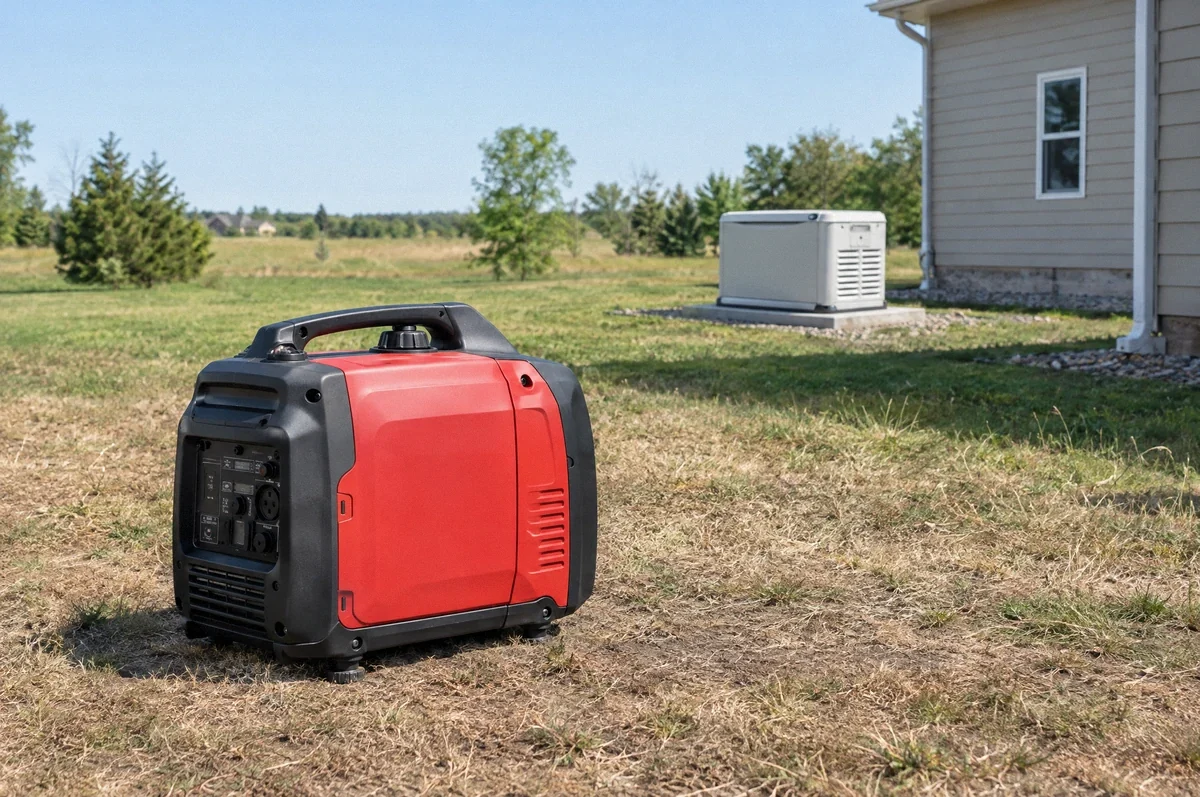
A portable generator can provide useful backup with a lower equipment commitment, but someone must safely position, connect, start, monitor, and refuel it. A standby generator is permanently installed and usually paired with automatic transfer equipment. It can restore selected loads while you are away, but it still requires fuel, maintenance, suitable placement, and an approved installation.
The better choice depends on the loads you need and who can operate the system during an outage. A generator that fits the budget but cannot be used safely on the property is not a workable backup plan.
Compare the operating responsibilities
| Decision | Portable generator | Permanently installed standby generator |
|---|---|---|
| Starting an outage | Usually manual setup and starting | Automatic operation with a compatible system |
| Location | Safe outdoor operating position must be available each time | Approved permanent location |
| Fuel | Storage, handling, and refueling according to the model | Usually a designed natural-gas or propane supply |
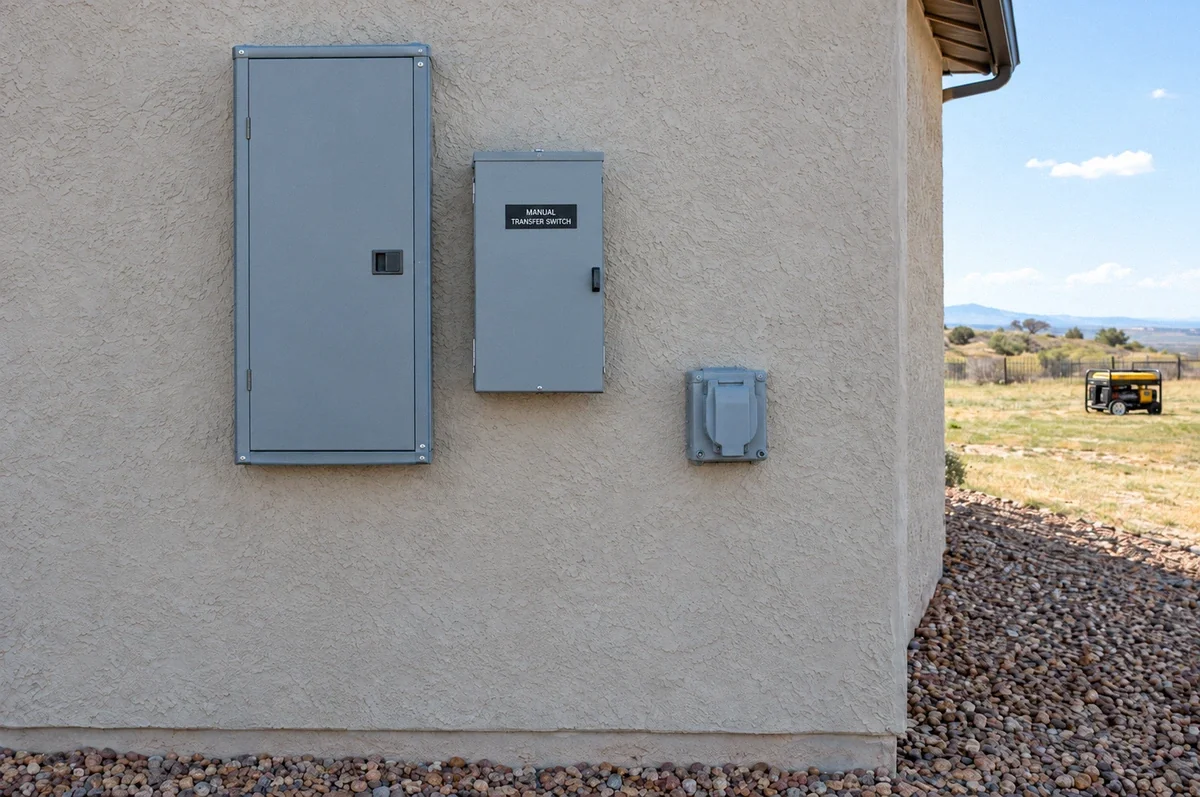
| House connection | Compatible inlet and approved transfer arrangement if feeding home wiring | Transfer equipment integrated into the installation |
| When nobody is home | Generally cannot be deployed | Can operate automatically, subject to system condition and supply |
| Maintenance | Engine, fuel, starting system, and other model requirements | Scheduled service plus extended-runtime checks |
These are common configurations, not a specification for every product. Some portable models use different fuels or starting systems. “Standby” describes the installation and operating role; it does not guarantee enough power for every circuit in the house.
A portable generator needs a feasible location
Portable generator exhaust contains carbon monoxide, or CO, an odorless gas that can be fatal. Positioning is a prerequisite, not a detail to solve after buying the unit.
The Consumer Product Safety Commission’s January 2026 safety guidance says portable generators belong outside at least 20 feet from the home, with exhaust directed away from nearby buildings. Do not run one inside a home, garage, basement, or shed. The same guidance says to shut the generator off and let it cool before refueling.
Consider neighboring windows, doors, and vents as well as your own. A balcony, porch, or enclosed patio is not a substitute for an appropriate outdoor site. Do not assume that opening a garage door provides adequate ventilation or that a CO shutoff sensor makes unsafe placement acceptable.
Wet weather needs a manufacturer-approved operating approach. An improvised enclosure can trap exhaust or heat. If the property cannot accommodate safe placement and weather protection, compare a different backup method instead of shortening the distance to the house.
Who will set it up and keep it running?
Assess the physical and practical work honestly. Can someone move the unit to its designated site, handle the approved cord, follow the operating instructions, and manage fuel safely? Can that person do so during darkness, poor weather, or a prolonged disruption?
An electric-start portable still needs setup, a maintained starting battery where used, and the same safe operating location. A large fuel tank does not eliminate maintenance. Stored fuel and fuel-system care affect whether the engine starts when needed. Generac’s portable generator FAQ addresses fuel and maintenance considerations for its equipment; use the manual for the exact model selected.
If the property must have power when nobody can perform those tasks, automatic standby or appropriately designed battery backup may fit better. Automatic operation still needs a plan for faults, maintenance, and an outage longer than expected.
Both approaches need a defined electrical connection
A portable generator can supply individual compatible appliances directly under its operating instructions. That is different from supplying the home’s wiring. Hardwired loads such as a furnace, well pump, or selected house circuits require a planned connection.
For home wiring, an inlet receives the generator cord and transfer equipment isolates the backup supply from the utility. A compatible, approved interlock arrangement may be part of the design. The inlet alone cannot provide that isolation.
Never connect a generator to a household outlet. Do not improvise a cord with two male ends or rely on remembering to turn off a main breaker. The transfer-switch guide explains the roles of the inlet, manual switching, interlocks, and automatic switching.
The electrician must also verify voltage, current capacity, circuit protection, and grounding and neutral compatibility. A high advertised wattage does not prove a portable generator can supply a specific 240-volt pump or the selected transfer arrangement.
Size the system for the loads that matter
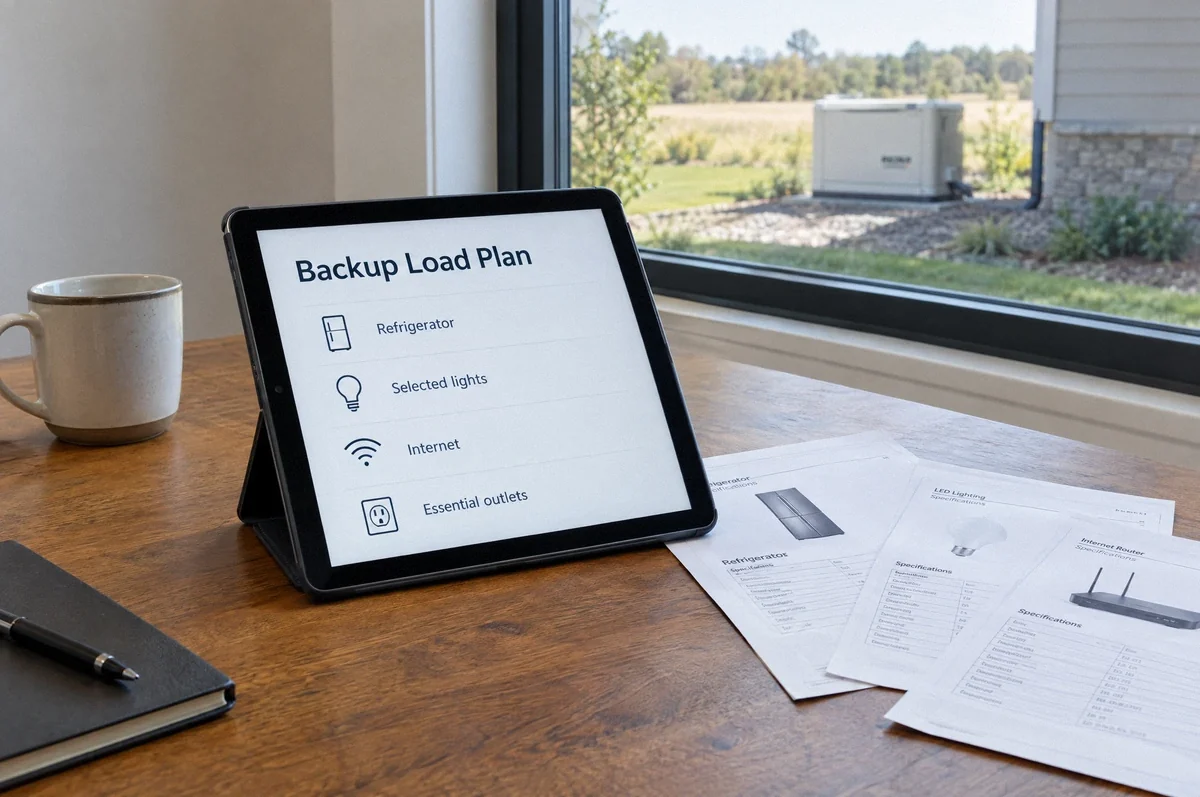
List refrigeration, lighting, communications, access equipment, pumps, heating, and any medically necessary devices. Then decide which large loads can remain off. Air conditioning or electric heat may be essential for some occupants, so do not remove those loads by assumption.
Motors and compressors may need more power when starting than while running. A generator must handle the expected combination, not only the sum of ordinary operating watts. The equipment’s actual starting characteristics and the generator’s transient capability matter.
Whole-home transfer equipment can make many circuits available while load management restricts what operates together. A smaller essential-circuits design may meet the household’s needs with fewer electrical changes. Neither design can be selected from floor area alone. Use our generator sizing guide to prepare the load list.
An automatic standby generator has a startup and transfer delay. Medical devices, computers, and other interruption-sensitive equipment may need compatible uninterruptible power support or a separate contingency plan. Confirm critical medical requirements with the equipment provider.
Standby installation adds site and fuel work
A fixed generator needs a location meeting its installation instructions and applicable permit, fire, noise, and siting requirements. Clearance from openings, neighboring buildings, service access, and the fuel route can determine feasibility before the electrical design is complete.
Natural-gas demand may require review of the meter and piping capacity alongside other gas appliances. Propane needs an appropriate tank, supply arrangement, and delivery plan. A continuing gas connection does not guarantee service during every emergency.
An extended outage can require maintenance interruptions even when fuel is available. Generac’s continuous-use guidance calls for additional attention during long runs. Compare the selected model’s requirements and the availability of service rather than assuming a standby unit runs for days untouched.
Noise comparisons should use actual equipment ratings under comparable operating conditions. An enclosed standby generator is not categorically quieter than every portable inverter generator. Location, load, distance, and the neighboring environment affect what people hear.
Compare full costs and consider a battery
Compare the portable package with the complete standby project: generator, transfer equipment, inlet or service changes, permits, fuel work, mounting or pad, restoration, and commissioning. Add ongoing fuel, maintenance, and any monitoring expense. A generator-only retail price is not a price for home backup.
A home battery avoids combustion exhaust at the property and can provide automatic backup in a suitable system. It has finite stored energy and needs a compatible way to recharge during a long outage. Solar production can help but varies with conditions. Our battery versus generator comparison explains power, stored energy, and combined-system limits.
Before choosing, also check smoke and CO alarm readiness and decide how the household will respond if the backup system fails. Do not make a single machine the only plan for a critical need.
Fox Electric can assess the electrical work for generator installation, including the transfer arrangement and selected backup circuits. Request an assessment with your essential loads, outage goals, and proposed equipment location.