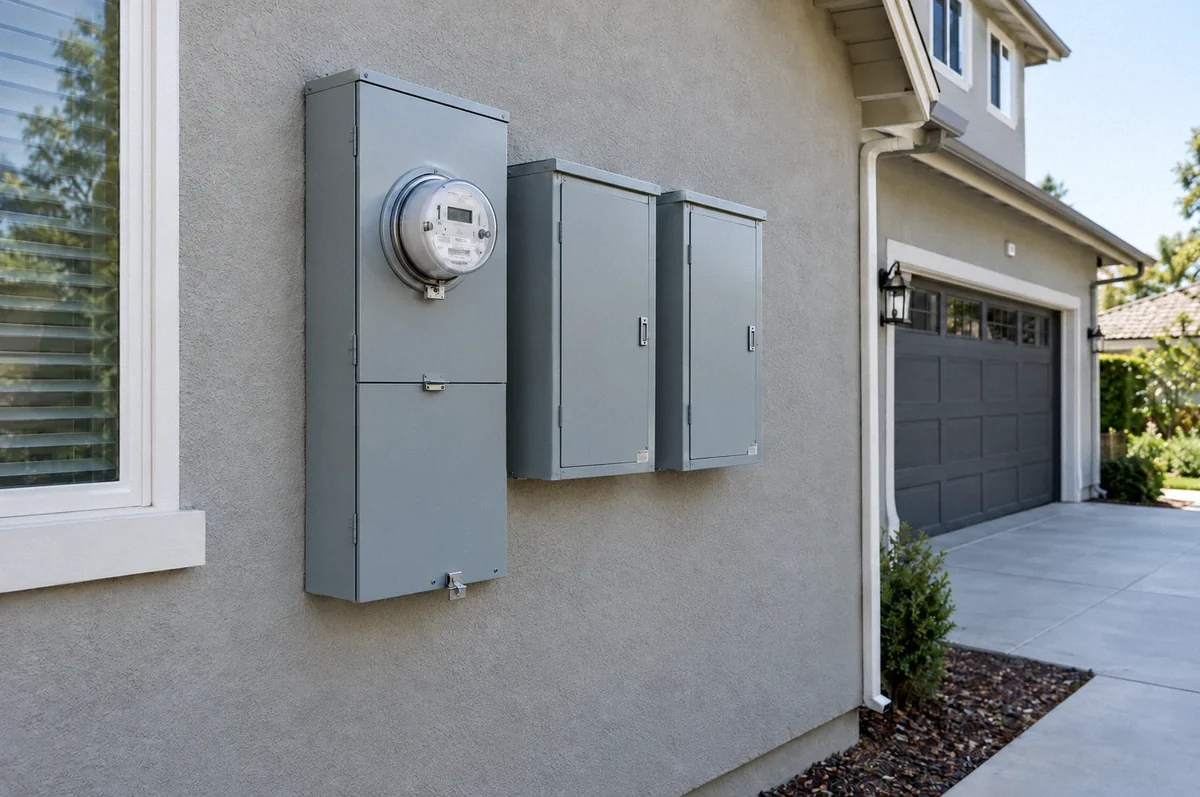
A subpanel is a distribution panel supplied from another panel or disconnect instead of receiving a separate utility service. It provides local breakers and circuit space for a garage, workshop, addition, or other area. It does not increase the total electrical capacity available from the utility.
That distinction answers the most common question about adding one. If the service has enough capacity but new circuits need a practical place to connect, a subpanel may be useful. If the service cannot support the new demand, adding breaker spaces alone will not solve the problem.
How power reaches the subpanel
The feeder is the set of conductors that carries electricity to the subpanel. An upstream protective device limits the feeder’s current according to the design. The subpanel then divides that supply among individual branch circuits for lighting, outlets, and equipment.
The panel’s label states an equipment rating, not a promise that the feeder supplies that amount. For example, a suitable panel rated for 125A may be installed on an appropriately designed 60A feeder. The usable supply is still limited by the feeder and its protection; the larger panel rating provides no extra service capacity.
Conversely, a larger feeder breaker cannot be installed merely because the subpanel label has a higher number. Conductors, terminations, upstream equipment, calculated load, and other conditions must support the arrangement. This is a design and installation task for an electrician, not a change to make by reading one label.
When a subpanel is worth considering
Several circuits in a distant area. A workshop may need lighting, general outlets, and individual equipment circuits. One properly designed feeder to a local panel can be more practical than several long branch-circuit runs back to the house.
Additional breaker positions. When a suitable existing panel is full but the service has capacity, a subpanel can create room for new circuits. The existing equipment must accept the proposed feeder connection using compatible components.
An addition or converted space. A new living area may benefit from a local circuit arrangement, especially when the original panel is far away. A small project with only one new circuit may not need a subpanel at all.
A detached building. A garage or backyard workshop with multiple loads may justify its own panel. The distance, underground or overhead route, building disconnect, and grounding requirements become part of the plan. The fact that a structure is detached does not automatically require a large feeder or multiple circuits.
An ADU. An accessory dwelling unit has its own household loads and access needs. A subpanel may supply it from the existing property service, but separate metering or another utility arrangement may be selected. Our ADU electrical guide explains why supply and billing decisions belong early in the design.
Subpanel size starts with the loads
A garage with lighting and occasional small tools is different from a workshop with large machinery or a garage with several EV chargers. Tell the electrician what will be installed, what may operate together, and what future equipment is realistic.
The design needs to consider both the proposed feeder and the upstream service. Spare capacity in one does not establish spare capacity in the other. An adequate main service may still have an undersized existing garage feeder; a large garage feeder does not fix an undersized service.
A load calculation evaluates demand using the applicable method. The number of breakers or the sum of their handle ratings is not the answer. Branch circuits do not necessarily draw their maximum current simultaneously, but their load cannot be discounted arbitrarily either.
The panel should also have enough suitable positions for the intended protective devices. The physical requirements of a two-pole circuit, arc-fault protection, ground-fault protection, or other equipment may affect the circuit layout.
Why the neutral and equipment ground stay separate
The neutral is a conductor that carries return current during normal operation of loads that use it. Equipment grounding connects normally noncurrent-carrying metal parts to an effective path for fault current back toward the supply source.
In a typical subpanel downstream of service equipment, the neutral is isolated from the metal enclosure and from the equipment-grounding bar. Bonding them together again can place normal neutral current on metal enclosures and other grounding paths. Schneider Electric’s subpanel neutral and grounding instructions illustrate this distinction for its QO and Homeline load centers.
For a typical new residential feeder carrying both 120V and 240V loads, the design includes two ungrounded conductors, a neutral, and an equipment-grounding path. Existing unusual arrangements require evaluation; they should not be copied into new work simply because the building has operated for years.
A detached building may also need its own grounding electrodes. Those earth connections do not replace the feeder’s equipment-grounding path. OSHA’s grounding explanation distinguishes the earth connection from the conductive path that helps a breaker operate when a fault occurs. Do not interpret ground rods as a way to omit the grounding connection between buildings.
Distance and routing can dominate the cost
The enclosure is only one part of a subpanel installation. A long feeder route can account for much more work than the panel itself.
The electrician should evaluate how conductors will reach the destination, whether walls or ceilings need to be opened, and whether the route crosses a driveway, patio, or another finished surface. Underground work also involves locating existing utilities and selecting a wiring method appropriate to the route and conditions.
Length affects voltage drop, the reduction in voltage along conductors under load. A long run may need a different conductor design from a short run serving the same demand. There is no single wire size that can be recommended responsibly from the phrase “100A garage subpanel” alone.
Placement matters too. A panel needs an accessible location with the required working space and environmental protection. A cabinet hidden behind shelving, a workbench, or stored equipment may create an access problem. Confirm the proposed position before the feeder route and wall finishes are finalized.
What happens if the main panel is already full?
The electrician must establish an approved way to supply the feeder. In some installations, permitted tandem or quad arrangements can reorganize circuit positions. In others, the existing panel may need replacement or a different distribution arrangement. A breaker that fits mechanically is not automatically approved for that panel.
PG&E’s electrification planning guide identifies subpanels as one option when circuit space is limited and the service load remains within its capacity. It is not a blanket instruction to add a feeder to every full panel.
If the service itself is constrained, compare a revised equipment plan, approved load management, or a service upgrade. Sometimes a project needs both a larger service and a subpanel to deliver that capacity to the new area.
Permits and the written scope
Plan a subpanel installation as permitted electrical work and confirm the required drawings and inspections with the city or county responsible for the address. A subpanel downstream of existing service equipment does not always require the same utility work as a meter or service replacement. The actual scope determines whether the serving utility needs to participate.
A useful proposal identifies the panel rating, feeder rating, circuit positions, route, approximate length, and included branch circuits. It should address detached-building grounding and disconnects where relevant, restoration of disturbed surfaces, and any corrections needed at the supplying panel.
For charging projects, distinguish the feeder scope from the EV charger installation. For a workshop, identify which equipment circuits are included. These details prevent an estimate for an empty panel from being mistaken for a complete usable installation.
Contact Fox Electric with the location, intended loads, and any plans for the building. A panel and distribution assessment can establish whether a subpanel solves the circuit-space and routing needs, and whether the existing service has the capacity to support it.