Choose between 200A and a larger residential service by calculating the home’s proposed electrical demand, checking the actual equipment ratings, and confirming what the serving utility can provide. Square footage, a luxury-home label, or the presence of two electric vehicles does not settle the question. The result depends on the loads and how they will operate.
There is also a terminology issue worth resolving before comparing estimates: a residential service described as “400 amp” often uses Class 320 metering equipment. That equipment is not necessarily rated to carry 400 amps continuously. A proposal should identify the meter equipment, continuous rating, disconnect arrangement, and approved load rather than relying on the shorthand alone.
What the amperage rating tells you
Amps measure current. On a typical 120/240-volt single-phase residential service, a 200A rating establishes a current limit for the service arrangement. It does not mean every appliance continuously draws part of that rating, and it does not give each individual circuit permission to exceed its own wiring and breaker limits.
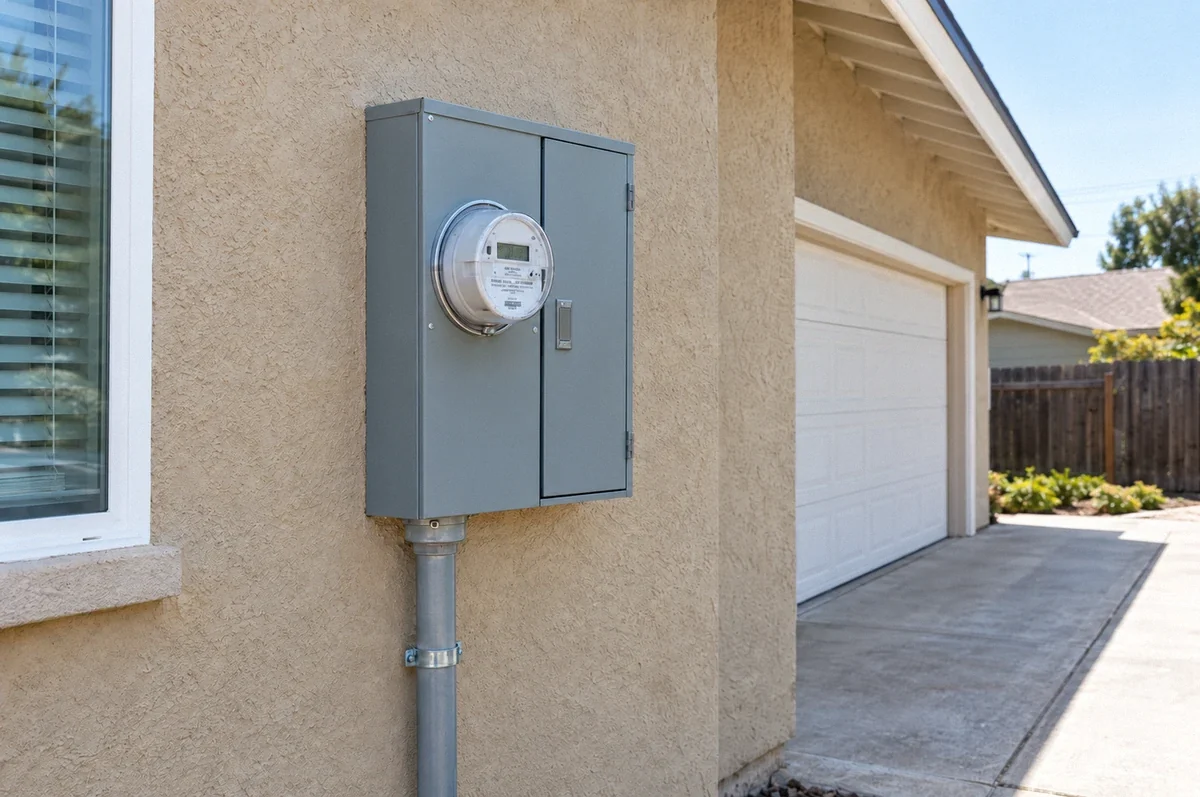
The main breaker is an important identification clue, but it may not describe the whole property. Some services supply more than one main disconnect. Some panels are downstream of another protective device. The enclosure or bus may have a higher rating than the installed service.
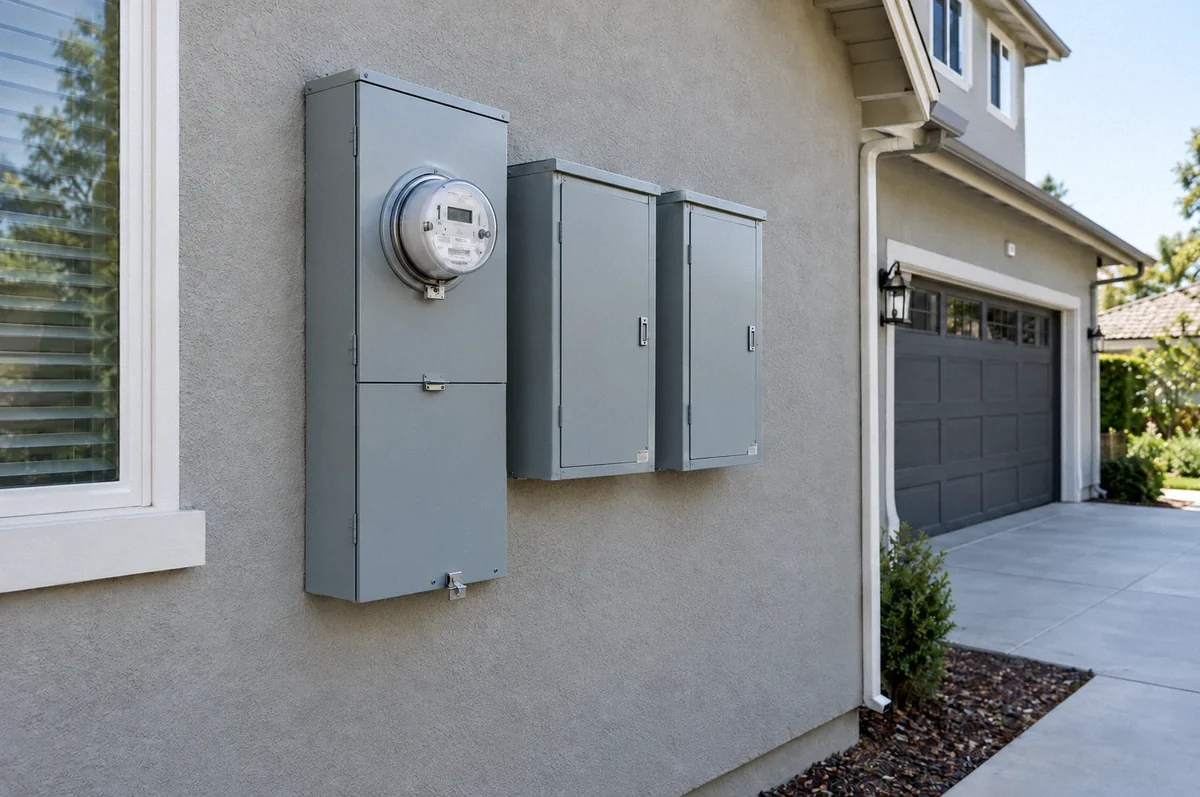
An electrician should establish the incoming supply, the main protection, and the ratings of the intervening equipment. Do not add the ratings of two visible panels and call the result the property’s service capacity without checking how they are supplied.
Build the load calculation around actual plans
A residential load calculation applies the permitted electrical-code method to the home and its equipment. It accounts for general household loads and specific appliances, including the appropriate treatment of loads that are continuous or do not operate at the same time. It is not the sum of every breaker handle or a guess based on the size of the house.
Provide the model numbers for heating and cooling, water heating, cooking, EV charging, and other substantial equipment. An electric tankless water heater may change the result much more than a heat pump water heater. A heat pump with electric resistance backup needs different consideration from one without it.
If an ADU is planned, include its appliances and living area rather than an arbitrary allowance labeled “future unit.” If a workshop will use a welder or other large equipment, provide those specifications too. Our load calculation guide explains how to prepare information that makes the sizing recommendation reviewable.
When 200A may meet the project
A 200A service can support substantial residential electrification when the complete calculation and distribution design work. That may include EV charging, electric cooking, and heat pumps, but no fixed list of appliances guarantees a passing result.
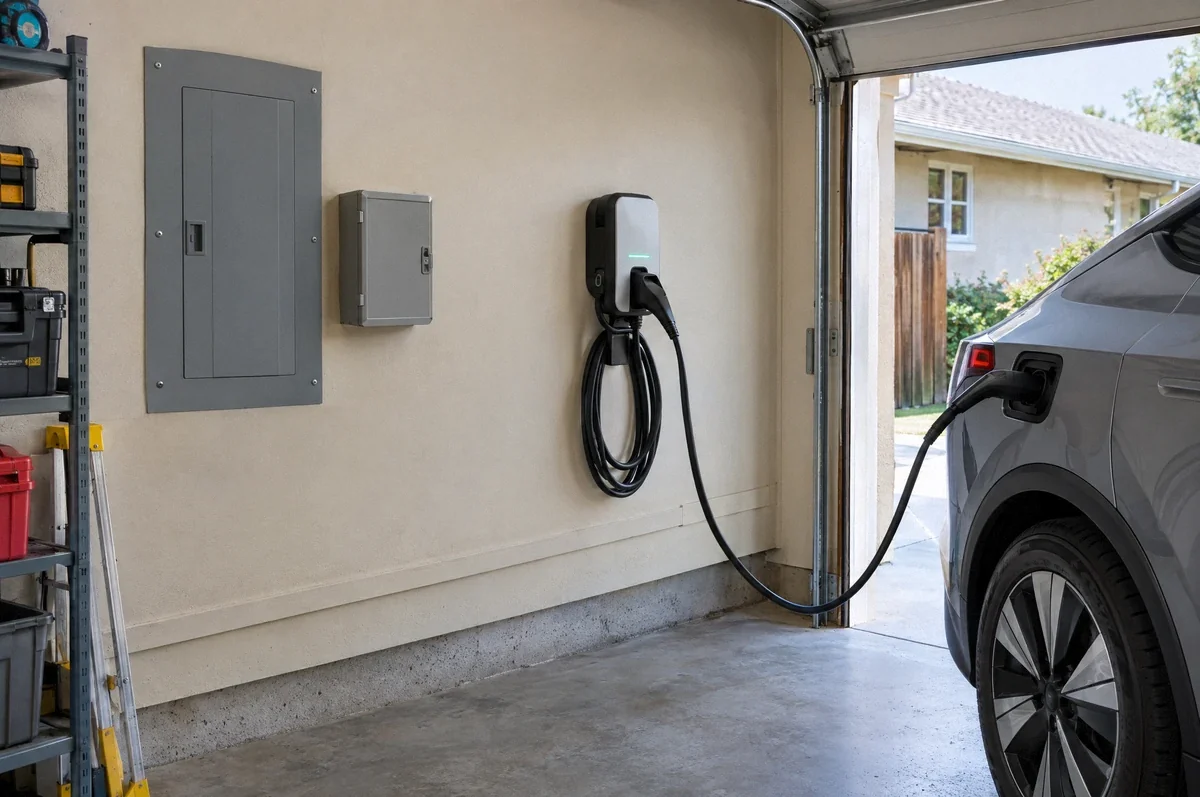
Consider an illustrative household that charges cars overnight and plans one heat pump. Before selecting the service, the designer can evaluate the actual HVAC nameplate, charging output, and other appliances. The household may prefer a moderate charging rate with little effect on everyday driving needs. Another household may need faster charging between frequent trips and place less value on delaying a load.
Those usage preferences help define a design. They do not replace the required calculation or an approved control system. A verbal agreement to “never run these together” is not equivalent to equipment that enforces the design’s load limit.
When a larger service deserves consideration
A larger service becomes relevant when the proposed loads do not fit within 200A using an acceptable design, or when the owner has specific additional capacity requirements worth paying for. Multiple dwellings, substantial electric resistance loads, several high-output chargers, and large workshop or pool equipment can contribute.
The combination matters more than the number of items. Two efficient appliances are not necessarily more demanding than one large resistance appliance. A heat pump that provides both heating and cooling is also not automatically two independent simultaneous loads. Backup heating elements and separate systems need to be evaluated according to their actual operation.
Ask for two explicit scenarios if there is a choice: the project that meets current needs, and the project that includes defined future additions. Compare the added capacity and the added construction. A larger service is easier to justify when the second scenario identifies equipment you actually expect to install.
Understand Class 320 before accepting a “400A” quote
PG&E’s residential service material guidance identifies Class 320 equipment for the 226-to-320-amp range and specifies markings such as “320 Amperes Continuous” or “400 Amperes Maximum (320 Amperes continuous).” This is why the trade description and continuous rating must be distinguished. See PG&E’s residential panel upgrade material list.
The design might use two main disconnects supplying separate distribution panels, or another approved arrangement. Two 200A disconnects do not, by themselves, authorize 400A of continuous demand through a meter socket with a lower continuous rating. The calculation and all equipment limits must agree.
If the project truly requires a different continuous capacity, the utility and designer must select the appropriate metering and service arrangement. Do not assume a product advertised online as a “400A panel” will satisfy that need or be accepted by the local utility.
Why the construction can change substantially
Larger service equipment may need more wall area, different working clearances, larger conductors, or additional distribution panels. An existing underground route may lack space for the proposed conductors. A change in meter location can affect both the electrical installation and building finishes.
Utility infrastructure is another variable. The serving line or transformer may require review or construction, but that outcome should come from the utility rather than a blanket assumption. Existing conduit should be evaluated before a proposal promises it can be reused.
Separate the cost of service capacity from the cost of reaching the loads. An ADU at the back of a property still needs a feeder route even after the main service is enlarged. A larger main does not eliminate the need for an appropriate subpanel and feeder or suitable branch circuits.
Compare managed loads with additional capacity
An approved energy-management system can limit selected loads when the home approaches a design threshold. That may offer an alternative to a larger utility service, particularly where utility construction is extensive.
For example, SPAN describes its PowerUp system as a service-capacity management feature that requires installer setup, load calculations, and local permit approval. This is a product-specific capability, not a feature every connected panel provides.
The tradeoff is operational: some equipment may pause or reduce output. Ask which loads are eligible for control, which must remain available, what happens if communication is lost, and whether the resulting behavior suits the household. Our smart panel guide separates monitoring from controls that can support a capacity-limited design.
Confirm the utility before finalizing the design
A project in San Mateo may follow PG&E requirements, while a project in Palo Alto or the City of Santa Clara may involve a municipal utility. Palo Alto explicitly warns that other utilities’ standards may not be acceptable under its electrical service requirements.
The local building department also reviews the permitted work. Utility acceptance and a building permit address different responsibilities; one does not substitute for the other. Resolve the meter arrangement and proposed rating before ordering expensive equipment or announcing an outage date. See the utility and inspection timeline guide for the coordination involved.
For a meaningful comparison, request the load-calculation result, final continuous rating, meter and disconnect configuration, future-load assumptions, and construction allowances. Contact Fox Electric for a service upgrade assessment that compares the capacity you need with the work required to provide it.